

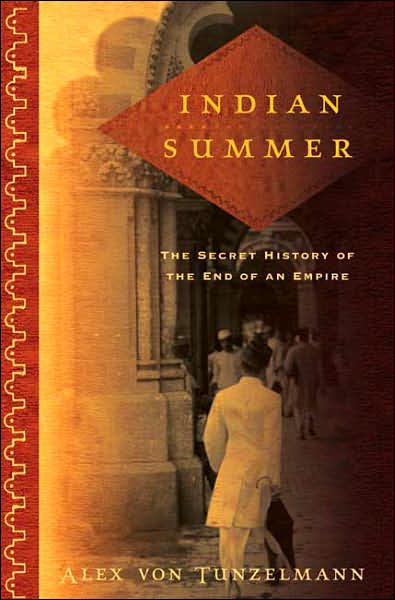
When I heard about a seminar on India at the Troy Public Library, I was very excited and braved the low temperatures and the icy streets to attend.We were to read, discuss, and connect a novel and a non-fiction book on India to India. I prefer non-fiction more than novels these days, so I am sharing this first. Way back during my time in India, I gave you some books if you , too, are interested in learning through the power of books. Here is one more. I was traveling yesterday, so I have not finished reading this but I think you can get the idea.
The Indian Summer is history that comes alive with von Tunzelmann’s narrative history-writing. You will meet all the main characters of the the story of partition of India: the triad of Gandhi, Nehru and Jinnah, the three men who shaped history, their personal history and their Indian public history. You will meet Lord Mountabatten and his wife Edwina, and the Duke of Windsor and how their lives and ideas intertwined to write the history of India. There are stories, too, of the common men and women and how their lives were affected because of the decisions made by the main characters. All together they joined the trail of the pilgrims’ progress of India.
I will use some of Ms. von Tunzelmann’s words to give you an idea of her elegant storytelling.
“On a warm summer night in 1947, the largest empire the wold had ever seen did something no empire had done before. It gave up. The British Empire did not decline, it simply fell; and it fell proudly and majestically onto is own sword. It was not forced out by revolution, nor defeated by a greater rival in battle. Its leaders did not tire or weaken. Its culture was strong and vibrant. Recently it had been victorious in the century’s definitive war.
When midnight struck in Delhi on the night of 14 August 1947, a new free Indian nation was born” Page 3 von Tunzelmann
“In the beginning, there were two nations. One was a vast, mighty and magnificent empire, brilliantly organized and culturally unified which dominated a massive swath of the earth. The other was an underdeveloped, semi-feudal realm rived by religious factionalism and barely able to feed its illiterate, diseased and sinking masses. The first nation was India. The second was England. The year was 1577. . . . . . . ” p. 11 von Tunzelmann
“India today is not Gandhi’s India, though there remains an enormous affection for him. There are element of Gandhi’s India in the nation’s spirituality; elements of Nehru’s India in its education, culture and technology; elements of Jinnah’s India in the parts that remain outside ; and even element of the Montabatten’s India in the continuing membership of the Commonwealth held by India, Pakistan, and Bangladesh. Though the echoes of 1947 still resonate around Kashmir, and Jinnah’s Pakistanis have taken a very different route from the one he might have wanted, the vast and diverse nation of India has its sights fixed firmly on the future. ” p. 318 von Tunzelmann.
This is incredible India! T I I I
For day 8 of zero to hero, I haven’t changed my about page, but I have submitted a post for the day.



 TalesAlongTheWay