Castel Sant’ Angelo

images (46)

From Google Public Domain


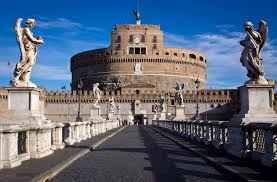
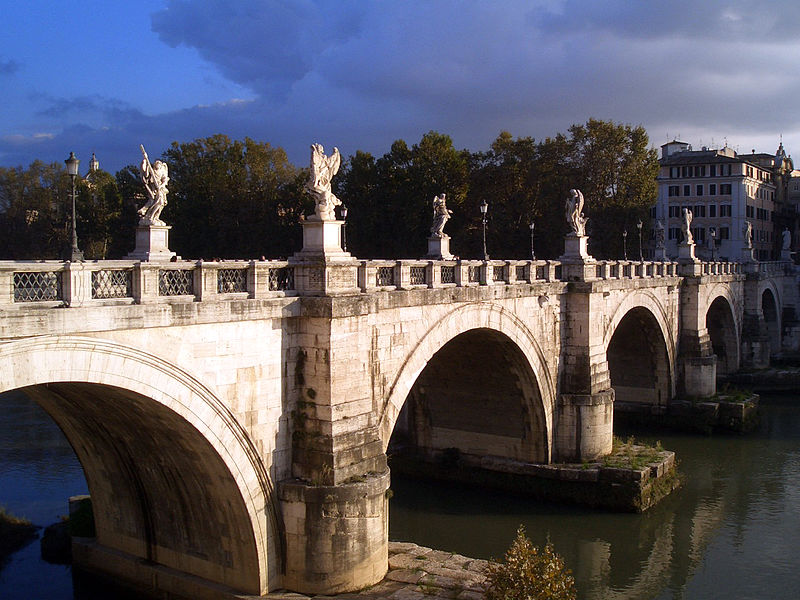
If you asked my son today, many years after our times in Roma with groups of students, he would tell you that the Castel  was and is his favorite site.  He has a picture or etching of this remarkable building  in his house.  The Romans were outstanding builders and you realize their talent when you visit building after building .  Our house in Troy was about 100 years old and we thought that was old.  The Castel was begun in 137AD and is still standing and functional. The building was originally built to be the earthly  final resting place for Emperor Hadrian and his family. Later it became a fortress  for the popes with direct secret passageway from St Peters to the Castile.  Today it is a museum.   Romans are good at adaptive reuse of her historical buildings! As much as Chris loved the  castle and the fantasies he had of playing “little boy army”  with his friends at home on this imposing site, I loved the Bernini angles which were added in the 17th century.

Bernini’s mark is large on  Rome with his beautiful architecture and sculpture and work at St Peter’s.  The professor says that Bernini was the first certifiable rock star  and he lived in the 17 Century.  He had a charming and outgoing personality and people would follow him where ever he went.   These angles were one of his last projects that he designed with his son who finished the work.

800px-Ponte_St._Angelo

Image from Wikipedia

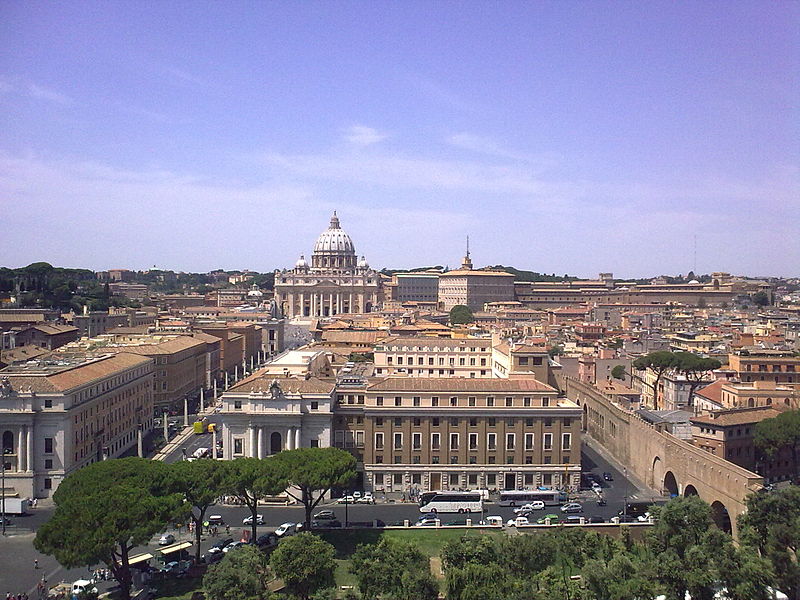
800px-View_over_Rome_from_Castel_Sant'Angelo

“View over Rome from Castel Sant’Angelo”. Licensed under CC BY 3.0 via Wikipedia – https://en.wikipedia.org/wiki/File:View_over_Rome_from_Castel_Sant%27Angelo.jpg#/media/File:View_over_Rome_from_Castel_Sant%27Angelo.jpg

St Peter’s Dome in the distance  and the passageway on the right that connects the two sites.

Oh what a lovely visit this morning to the Eternal City !  Did you know that the title started  during ancient Rome?  They Romans though that no matter how many empires came and went in the world , that Rome would  lead  and last forever!

I would love to hear about your experiences in Roma, dear friends! 

Posted in Architecture, Travel, Uncategorized | Tagged , , , , , , , , , , | 6 Comments

Grandma at the Window

Screen-Shot-2015-10-20-at-3.07.30-PM-1024x577

‘Grandma in the window’ shares special bond with students that goes beyond a wave

by Alexandra Zaslow
TODAY.com
It has become a daily routine for the students on bus No. 7 in Arlington, Washington, to wave to the “grandma in the window.”

Every day for the past five years, you could find 93-year-old Louise Edlen sitting at her dining room table as the busload of schoolkids passed by.

But one day in early October she wasn’t in her usual spot, NBC affiliate KING 5 reported.

grandma in window
Courtesy of Arlington Public Schools
After a few days of not seeing their old pal, the kids got worried. Eventually, they learned she had suffered a stroke.

“It was kind of heartbreaking because she was always there,” seventh-grader Axtin Bandewerfhorst told the station.

But she was apparently still thinking about the 90 boys and girls who zipped past her home every day.
The day after bus driver Carol Mitzelfeld brought Edlen a bouquet of flowers, the kids looked out the window to find a sign reading, “Thank You.”

“That made me really smile,” 10th-grader Cheyanne Holt said. “It shows how much we mean to her.”

So to welcome Edlen home from the hospital, they made her a sign of their own: a photo of the kids waving from inside the bus, the station reported.
“Carol was telling us that a lot of times she doesn’t remember her daughter’s name, but she always remembers to wave to the kids on the bus,” Bandewerfhorst said.

“That made me feel really special.”
Louise’s husband of 53 years, Dave Elden, with whom she has 30 grandchildren and 23 great-grandchildren, says the students’ daily gesture “means the world” to his wife. So they posted a “thank you” poster for the kids to see.

Screen-Shot-2015-10-20-at-3.07.22-PM-1024x565-1024x565

“It gives her something to look forward to every day,” he told KING 5.

Meanwhile, Elden has returned home, and is back to waving to the students every day.

Posted in Uncategorized, USA | Tagged , , , , , , | 6 Comments

The Alhambra , Granada Spain

Alhambra-arabic-caligrafi

The exquisite Muslim calligraphy at the jewel of the Moorish empire, the Alhambra,  in Granada Spain. Google Public Domanin

This is one of my all time favorite places i have visited,  even though it was years ago that we were there.  We actually drove around Spain with our two children in a little car without air condition or even a radio.  There was much bickering. . . . “She is in my space!’ and “He is looking at me!”  Two weeks we spent in Spain, which is a rather large country by European countries.  Though we really enjoy travelling by train, have a rental car allows more flexibility in visiting contemporary architecture.  The historic buildings are in the center  but obviously the contemporary are  more in the outskirts of the cities.

I have mentioned before how the architect would promise  a garden visit in the afternoon if the kids were good as a reward to visiting church after church. The clever kids would ask dad, “How come you visit all those churches over here but don’t go to church at home?”  He would just laugh! Grande was near the end of our time in Spain, due to its location way south near the Mediterranean and North of Africa. I remember hordes of gypsies  just outside the gate who were there to  ask for money as the tourists entered or exited.  Just like at the Taj Mahal, no beggars were allowed on the site which honestly does improve the visit.

All this background is to say that after  two months of touring, we were pretty well seasoned travelers even the 12 and 6 year old. I am not sure if it was intentional , but it seemed that David had saved, if not the best, at least one of the  best sites we saw during that time.

The lovely palace was open, filled with Muslim calligraphy, tiles and open to and winding among the gardens.  Honestly, we spent 6 hours exploring the wonders of it all .  And neither the children nor I complained once!   You just have to see and experience it!

In May, 2013 at the end of our first time in India, some of the students were planning some detour  trips as they made their  way home.  Tyler and Liz were planning European sites including Spain.  I, of course, suggested the Alhambra.  They said it was so far out of the way of the other Spanish sites, but of course I went on and on.  Later , David said, “Good grief, you do go on and on ! Nothing will live up to your description!”  Well, the went, and of course are architects.  Tyler  sent a card showing a picture of the beautiful gardens and fountains.  ”  Dear Miss Anne!  We found the Alhambra even more beautiful that you described!”  Whew, I was relieved and David just laughed!”

alhambra-articleLarge

Google Public Domain Image


Have any of you visited the Alhambra?   Have you heard of it before?  

Posted in Architecture, Religions of the World, Uncategorized | Tagged , , , , , , , , , , , , , , , , , | Leave a comment

A Temple, a Living Fort, and a Camel !

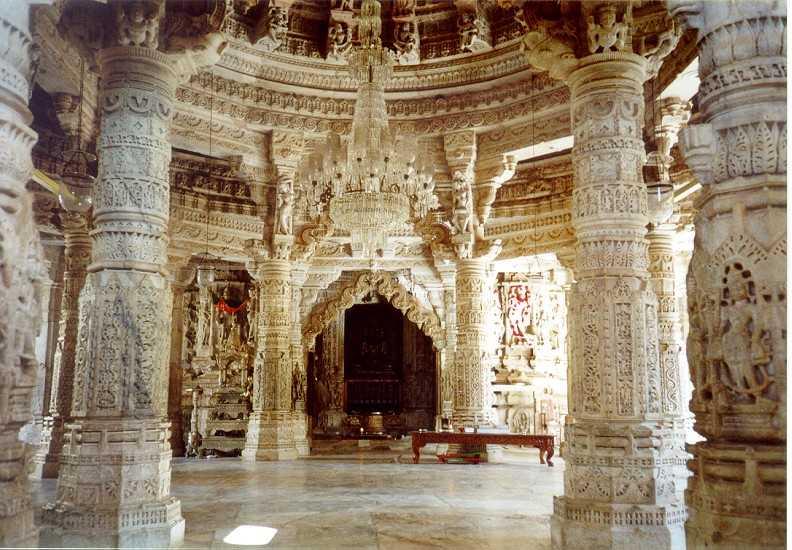
ranakpur1

Ranakpur is  the jewel in the Jain temple crown. Visiting these  temples is an exercise in pilgrimages.  I have shared  the 2.5 miles climb  up the 4000 steps  up to Palatana.  This temple is not up a mountain but the road to reach there is a climb up and then a windy road down.  The temple is at the end of the road at the bottom of yet another pilgrimage.   The 1,400 individual columns are hand carved  and each unique.  What a great idea to let the marble craftsmen , design and carve their own column. I just imaged the families coming to pray and the dad point out and explaining the columns he carved with great pride in his contribution. This is the temple where the student priest asked to pray for our group and we gathered around, sitting on the floor and he prayed.

The second half of the 6 minute video is about Jaisalmer , the Golden City.  It is one of my favorite Indian sites after our visit in January. The Haveli  were built by the merchants  and remind me of Petra which I have only seen in images  but always wanted to see in person.  I love the living fort which reminded me of Venice. Ironically Venice is having ongoing problems with destructive water and the Fort at Jaisalmer has a crisis for little to no water in the desert!   Near the fort  is the place where we slept in the desert and rode the Bedouin camels.

This is Incredible India! 

Posted in Animals, Architecture, India, Religions of the World, Uncategorized | Tagged , , , , , , , , , , , , | 2 Comments

Who Doesn’t Love the Bhangra?

1317417060-navratri-raasgarba-mahotsav-celebrations-in-india_852309The new PM of Canada, Mr Trudeau sure does!

Thanks Judy!

Posted in India, Uncategorized | Tagged , , , , , , , , | 9 Comments

Pets at the Pantry. . . . ConSERNS-U

dog_2170178btop_molly (1)

A cat and a dog at the food pantry?  Really? Well , not literally but figuratively. I have to admit that I was surprised that we have pet food donated by the animal shelters.  Why?   I have written about the great love pets and people have and clients of food pantries are no different. At the end of the shopping when , the shopper volunteer  goes into the back room to select 3 special items, usually detergent, soap, toilet paper, or shampoo,  the client will ask about pet food.  Sometimes the cupboards are bare.  We can not give things to them if there are none available.   But at the moment we have huge bags, 40 pounds or larger for distribution.  The volunteers fill plastic bags with dry food to give out several pounds or so for the pets of clients.

This gift of generosity is a love for the pets and  their well being. The experience is that people will feed their pets as long as they possibly can, but when they are at the end of the pet rope, they will just put them out on  their own to fend for themselves.  Then because feral dogs don’t roam our streets as they do in India, they will end up in shelters and need feeding and care anyway.  The SPCA tried to break that cycle by provided food to the owners so that they and their pets can stay and love together.

Your thoughts? 

images by Google Public Domain

Posted in Animals, Uncategorized, USA | Tagged , , , , , , , | 2 Comments

“Sicario”. . . . a film

Main-Quad_AW_29617-Sicario

In Spanish, Sicario means hit man.   David and I saw this last weekend.  It is an intense drug trade thriller where you will be confused, at least at the beginning, as who are  the good guys and who the villains.  There are no white hats in the film.  The clear world of right and wrong are no longer absolutes.   Kate, a young FBI agent played by Emily Blunt, tries to hold on to her moral compass though the ground keeps shifting.

The cinematographer Roger Deakers uses aerial shots of the border crossing, the wild chase through the drug tunnels, and long shots of expressive faces to add to the mystery and excitement of a “haunting jungle” of the the cartel wars in and around the border.

This is a morally dense and thrilling look at the people, politics, and power that controls the  drug trade  on the Mexican/US border.

Rolling Stone and Christianity Today movie reviews

Post Script:  There is a story, though not in the film, that the drugs lords from Mexico live in the American section of Juarez so their families have a peaceful life, while they do business in the Mexican section of the city over the Rio Grande in Mexico.   The film seems to validate that .  Wait until you see the  traffic jam scene at the border!

Have any of you seen “Sicario?” 

Posted in film, Uncategorized, USA | Tagged , , , , , , , , | Leave a comment

Fragility of Democracy

man_dradri

Man killed by Indian mob. . . . The Indian Express  ( New York Times)

Thirty-five leading Indian authors and poets have returned coveted literary award to protest the violence that is creeping into Indian corporate life under the Hindu Nationalist government of Narendra Modi.

This protest began in September when a 76 year old anti-Hindu man was  killed in his home.  another red light is Mr. Modi failing to promptly   condemn  the killing of this Muslim man by a Hindu move because they suspected he had killed and eaten  the meat of a cow.

Indian Writers Return Awards to Protest Government Silence on Violence

Cattle Become a Trigger for Sectarian Violence in India


With Return of Prize, India’s Literary Stars Protest Rising Intolerance

By THE NEW YORK TIMESOCT. 17, 2015
Photo

Indian activists, seeking an investigation into the beating death of a Muslim man, shouted slogans against Prime Minister Narendra Modi during a protest in New Delhi on Oct. 6.

Prominent writers in India are collectively protesting what they consider an increase in hostility and intolerance, which they argue has been allowed to fester under the  government of Prime Minister Narendra Modi, by returning a prestigious literary award.

Mr. Modi,  please remember the 2002 Gujurat riots which included the burning of a  train, and the killing of many Muslim people in retribution.   You were under suspicion, investigation, and even  trial for years because at the very least you failed to do all you  could to protect the Muslims.  Now you have been deemed “not guilty” for those riots, and I hope you have learned your lesson.  You are the PM of all of India, the largest democracy of the world.   You must remember and act on the fact that you are responsible for the safety of all of India and Indians with the multitude of faith systems. 

Democracy is a very fragile and fleeting gift! 

Posted in India, Religions of the World, Travel, Uncategorized | Tagged , , , , , , , , | Leave a comment

Discovery in the Mexican Reservoir

400-year-old church re-emerges from beneath Mexican reservoir

400-year-old church re-emerges from beneath Mexican reservoir
The remains of a mid-16th century church known as the Temple of Santiago, as well as the Temple of Quechula, is visible from the surface of the Grijalva River. (AP photo)

The relics of a 16th-century church built by Spanish colonisers has emerged from a reservoir in the south of Mexico.

It is the second time the church, usually submerged on the reservoir bed, has been revealed in the state of Chiapas as a result of drought.

A water level drop of at least 80 feet in the Grijalba river which feeds the reservoir has revealed the 400-year-old roofless religious building, with its 10 metre high walls, 61 metre length and 14 metre wide hall.

The river was last this low in 2002, when visitors were able to walk about inside the church.

Today, fishermen are ferrying curious passengers around the ruins, which were submerged in 1966 when the nearby dam was completed and the area flooded.

Architect Carlos Navarrete, who worked with authorities on a report about the building, said: “The church was abandoned due to the big plagues of 1773 to 1776.”

It is linked to a famous figure in Spanish history, namely Friar Bartolome de las Casas, who arrived in the Quechala locality in the mid-16th century with a group of monks that built the church.

Bartolome de las Casas was the first Bishop of Chiapas and initially supported the colonisation and subjugation of the native Indians of the region.

In later years, however, he advocated strongly for the abolition of slavery, both in situ and back in the Spanish court of King Charles V.

He managed to get the New Laws passed in 1542 which curtailed many of the slavery practices in Peru. They were so unpopular with settlers in the South America that King Charles backed down and removed some of the most important aspects of the legislation.

The church depended on the nearby monastery of Tecpatan, and was on the Chiapas’ king’s highway, built by Spanish settlers and still in use in the 20th century.

As cool as this picture is, it is really scary that the water has receded this much. My son works for an international company that is all about water across the globe.  Chris says that  there will be wars over water or lack there of.  We can not survive without it!   I believe it! 


Posted in Architecture, Travel, Uncategorized | Tagged , , , , , | 2 Comments

A Generous Heart. . . . .Mother Henny

I hope people will have time to read about this extraordinary woman. There is so much hatred  today, as there  was down through history, towards the Jewish people. My thoughts have been that there are always good and bad people in all cultures, all religions. Read and be inspired  by the love and generosity of Mothere Henny.  How  her love will be missed in this city continually attacked with hatred !


Henny Machlis: A Truly Great Jewish Woman

How did an ordinary Jew from Brooklyn become one of the greatest lights of our times?

by

What qualified Henny Machlis, who passed away this past Friday at the age of 58, as one of the world’s greatest Jewish women?

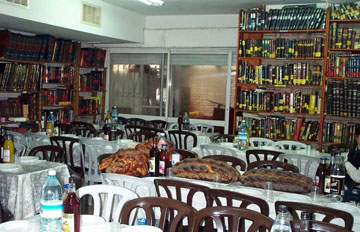
Jerusalemites would say it was her cooking for and serving up to 300 guests every Shabbos in her cramped Jerusalem apartment. The guests – almost 150 for the Shabbat night meal and over 100 for the Shabbat day meal – ranged from curious tourists and university students to lonely widows and singles to drunks and mentally ill people who considered the Machlis family’s love and warmth more delectable than even their ample food. Henny cooked 51 weeks a year (except only for the week of Pesach) from her tiny kitchen. Starting as newly-weds 35 years ago, the Machlises’ open Shabbos table expanded gradually over the years until the overflow of guests had to be seated in the courtyard and outside the front door. Henny’s great dream was to enclose the courtyard so guests could sit there even in the winter. Alas, she never lived to see her dream’s fulfillment.

njAmidTheStrife

A peaceful Shabbat meal at the Machlis home in the midst of strife. . . . . .

The Machlises’ chesed was not restricted to Shabbat. Homeless people slept on their couches, some for weeks at a time, and those whose mental instability might have endangered the Machlises’ fourteen children were accommodated in the family van. When Rabbi Mordechai Machlis would leave for work as a teacher in the mornings, he would know how many van guests he had by the number of shoes in the windshield.

For those who gauge greatness by the level of selflessness a person attains, Henny also scored off the charts. At her funeral her oldest son Moshe recalled how, after he got married and moved away to start Kollel (full-time Torah learning), his mother encouraged him: “If you ever aren’t making it financially, tell me and I’ll sell my jewelry.”

“Ima,” Moshe called out in a tearful voice, “you forgot that you didn’t have any jewelry. They had all been stolen by the guests over the years. And your diamond ring – you loaned it to someone twenty years ago, and never got it back.”

Being treated for cancer in New York’s Sloan-Kettering, Henny was sometimes visited by the unfortunates who – even those decades older than she – considered Henny their mother. When one homeless woman came to visit, Henny gave her her bed. A relative discovered Henny, wrapped in a hospital blanket, wandering in the hospital corridor looking for a place to lie down.

Henny’s son Moshe was pushed aside at the crowded funeral by one of the Machlises’s mentally ill “regular guests,” who proclaimed, “I have to get closer. She’s my mother.”

For those who equate spiritual greatness with God-consciousness, with the ability to see God’s hand always and everywhere, Henny had indeed achieved those spiritual heights. At the funeral, a tearful Rabbi Machlis related just one story: He invited a destitute man whom he always saw at the Kotel (Western Wall) to come home with him to eat. That day Henny served her homemade whole-wheat pizza. The man loved it. He came back to their house every day asking for a slice of whole-wheat pizza. Finally, Henny suggested that she could teach him how to make whole-wheat pizza himself. Painstakingly and with infinite patience, Henny taught him how. One night several days later, at 3 AM, there was a knock on the door. “Not on the front door,” Rabbi Machlis related. “Our front door is always unlocked. Someone was knocking on our bedroom door.”

The loud knocking woke them up. Alarmed at what must be an emergency, Rabbi Machlis went to the door and asked, “Who’s there?” When the man identified himself, Rabbi Machlis asked, “What’s wrong?”

The man replied, “I forgot how to make whole-wheat pizza. I need your wife to explain it to me again.”

Rabbi Machlis was exasperated. “At 3 o’clock in the morning, you need to remember how to make whole-wheat pizza?”

But Henny calmed him down. “It’s a test,” she assured him. “It’s from Hashem.”

Then Henny reiterated to the man, step by step, how to make whole-wheat pizza.

Henny emanated radiant joy all the time.

For me personally, the sign of Henny Machlis’s greatness was the radiant joy she emanated all the time. Whenever I ran into her, her wide smile and the joyful light she radiated conveyed that seeing me was the best thing that had happened to her all day. And although I knew that she greeted everyone the same way, I nonetheless was charged by this encounter with a holiness and saintliness that lit up the world – or that tiny piece of the world where Henny Machlis stood.

The last time I saw Henny was several months ago, when she was briefly back in Jerusalem between surgeries and treatments at Sloan-Kettering. She had already been battling metastasized cancer for a couple agonizing years. I decided to drop in at her house, and braced myself to see the battle-weary and fear-worn look that characterized other cancer patients I had known. On the path to the Machlis house, there was Henny with one of her daughters, on her way to go to pray at the grave of the tzaddik Rav Usher. When she saw me, she gave me that same radiant smile and jubilant greeting that had always been her trademark – unmitigated by the cancer, the surgeries, the chemo, the long separations from her family, and the unexpected – and unwanted – turn her life had taken. Her joyful smile conveyed not just her stoic acceptance, but her happy acquiescence with the way God was running His world.

A mutual friend told me after Henny’s death, “When I was with her, I felt embraced by God.”

The question – indeed the challenge – of Henny’s life is: How did an ordinary Jew born to a regular middleclass family in Brooklyn in 1957 become so great?

Henny kept on going and giving and loving and inspiring.

Like the rest of us, she went to college. (She graduated Stern College with a B.S. in education.) Like most of us in our twenties, she had an ideal. Hers was to share the beauty and joy of Shabbos with the whole world. Like most of us, “reality” intruded in the actualization of the ideal. For the Machlises, the tremendous scale of their success cost them over $2500 every Shabbat, a financial load that defied Rabbi Machlis’s modest salary as a teacher supplemented by donations from well-wishers. But unlike most of us, their adamantine faith in God and love for the Jewish people kept them from compromising on their ideal. They mortgaged their apartment to the hilt, took out personal and bank loans – and kept on going.

As Henny once told me: “We are living in the midst of a spiritual holocaust. Most Jews today have no idea of the beauty and depth of Judaism. How can we not do everything in our power, including going into debt, to reach out to our fellow Jews?”

The only difference between Henny Machlis and the rest of us is the voice that asserts, “I’ve done enough. I don’t have to do more.” Henny never harkened to that voice. She kept on going and giving and loving and inspiring – until last Friday, when she was called to her Heavenly reward.

Now it’s up to the rest of us.

Posted in Religions of the World, Travel, Uncategorized | Tagged , , , , , , , , | Leave a comment