I had not read the book and had been told the plot only that this is similar to GONE GIRL. It is not and way more dark and sinister . I wish I had not seen it as images are still with me today since I saw this yesterday. The train takes suburban workers daily into the city and back home in the evening. A sad alcoholic woman looks as lives fly by, imagining and obsessing on the details of people she saw.
That is enough of the story. There is divorce, drug abuse, lies, affairs, emotional abuse, and horribly broken relationships. I don’t recommend that anyone see this film even though so highly advertised. It seems to me to be the epitome of this post-modern world of broken, throw- away people.
But I am curious , if you have seen it and have a difference of option. Please write and share with me ! It wouldn’t be the first time, that I am off base !
A police official, right, escorts two men outside the court in Thane, outskirts of Mumbai, India, Thursday, Oct. 6, 2016. Indian police have arrested 70 people and are questioning hundreds more after uncovering a massive scam to cheat thousands of Americans out of millions of dollars by posing as U.S. tax authorities and demanding unpaid taxes. (AP Photo/Rajanish Kakade)
NEW DELHI (AP) – Indian police have arrested 70 people and are questioning hundreds more after uncovering a massive scam to cheat thousands of Americans out of millions of dollars by posing as U.S. tax authorities and demanding unpaid taxes, a police officer said Thursday.
According to police in Mumbai, the yearlong scam involved running fake call centers which sent voice mail messages telling U.S. nationals to call back because they owed back taxes.
Those who called back and believed the threats would fork out thousands of dollars to “settle” their case, Mumbai police officer Parag Marere said Thursday.
The scam brought in more than $150,000 a day, Marere said without giving a total sum. If the scam netted that amount daily, it would have made almost $55 million in one year.
Some victims were also told to buy gift vouchers from various companies, and hand over the voucher ID numbers which the impostors then used to make purchases, Marere said.
Police said they are likely to file charges against many of the 600 or more people still being questioned on suspicion of running the fake call centers, housed on several stories of a Mumbai office building.
Those arrested so far include several of the alleged ringleaders, as well as people accused of providing equipment and setting up the fake call centers. The criminal charges filed against the suspects include extortion, impersonation and violations of India’s information technology laws.
“We are questioning those who were involved in the fraud, including those posing as tax investigators,” Marere said.
Police raided the offices this week and seized hundreds of hard disks, hard disks, high-end servers and other electronic equipment.
Indian media reports said 70 percent of the scam’s proceeds were retained by the suspects in India, while the rest was paid to collaborators in the U.S.
Indian news broadcaster NDTV reported that one U.S.-based company allegedly collected the victims’ personal information and passed it to the fake call centers.
The IRS reports receiving more than 900,000 complaints about similar scam calls since October 2013. More than 5,000 people have fallen for the scam, paying out more than $26 million collectively as a result of scams.
The IRS has yet to comment on this recent arrest in India.
The IRS warns it will never call and demand immediate payment. It will never require you to use a specific payment method for your taxes, like a gift card or prepaid debit card. The agency will never ask for credit card numbers over the phone.
If you receive a call form someone claiming to be from the IRS and asking for money, you should never give out personal information. Report the call to the IRS using their “IRS Impersonation Scam Reporting” web page. You can also call 800-366-4484.
Top News
This is not Incredible India, my friends! Actually my husband got one of these calls, but thankfully he didn’t lose any money. He said it was very convincing, though. Be careful and remember the IRS NEVER calls but send mail to give you “good news” of owed funds.
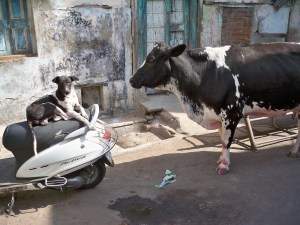
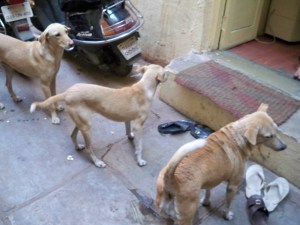
They come in various colors, white, a ginger brown, black, and mixtures of the three. A few have long coats and all have pointed snouts. And they are not pets, or so we thought. The dogs live in the street scrounging in the sweeping piles and jumping with strong legs to scale a low fence for a morsel. They are “hunters and maybe gatherers,” just trying to survive. Their ribs show prominently through their skin and they are caked with mud. The Indians ignore the dogs except if there is a fight between the males for territorial rights. Then they yell and wave their hands.
The picture shows Ginger and Burnt Marshmallow with one of the puppies in front of our hostel # 7. ( That is DBell standing at the gate.) The male dogs live and control a pack of several females and various puppies in our lane. They rarely venture out into the busy street at the end of our road, but they”work” every morning trotting, one on each side, as our guards, as we walk to the end of their territory. They don’t run and jump up on us, or bark or demand any attention whatsoever. We are in parallel universes. As we head to the rickshaw stand, our dogs snarl and bark ferociously at the pack across Samved Hospital Road. (Yes, a city of 5-6 million has unnamed streets.) I sent these pictures to my friend Donna who taught at an International School in Egypt. To my surprise, she said the Indian dogs are cousins to the Egyptian ones and look the same. Packs roam the village streets and into the desert in Egypt and they are killed by the Egyptians. This is probably the case because dogs are considered unclean in Islam. Bowls of milk are left outside for feral cats. Student alert: Remember when we talked about the ancient Egyptians worshiping cats, especially the hairless cat? There is even a cat mummy in the Albany Institute of Art. It seems that five thousand years later, cats are still revered in Egypt.
On the a fore mentioned street known as Samved Hospital Road, we made an Indian friend. We were walking to a favorite restaurant when half a dozen dogs scooted in and out of traffic to reach a man standing on the sidewalk. This was Sunil, a social worker in Ahmedabad. He has adopted this pack of dogs, taking them to a veterinarian for neutering and vaccinations; plus, he regularly feeds them with scraps and bread crusts. Laughing, he commented, “The dogs know my license plate, so they come.” One Indian trying to do what he can by entering, if only momentarily, the canine universe of the city streets.
David and I have resisted touching our guard dogs or the ones at the University until last week. The first time was a quick pat on a dog’s head, followed by a big dog smile. Next, I started calling them by the names I had chosen for them, Burnt Marshmallow, and Ginger. They respond with a vigorous wag. Could they understand English? Oh, it must be my tone. The students have been placing their left-overs on the trash piles for sometime. It seems we have dog friends in Ahmedabad.
The most touching feral dog story happened on our first trip to the old city market which was filled with teaming masses, wonderful sights, smells, and sounds. As we wandered in and out of ancient streets looking side to side, trying not to miss a thing, something caught my eye at the end of a street next to a display of flowing, vibrant scarves. There was a low table with a very old dog lying on the top. He was stretched out, eyes closed, and his legs straight out. He appeared to not be breathing. Next to him was an elderly Indian, standing quite still, looking down. Now, the dog could have been sleeping there, I guess, but this is not a usual sight. To my mind, the man had placed the old dog on the table for a more comfortable passing, and he was standing next to his friend in order to be with him to the end. I understood as I, too, have loved and lost a very special dog friend. (from a post in 2013)
Our trip began at five in the morning for a one-way five hour tour coach ride. Travelling in the country is slow going as many of the roads are only two lanes. It was quite nerve wracking as I had not learned to close my eyes, but watched as the cars, wagons, and bikes would seemingly play chicken with oncoming traffic while trying to pass. At the last minute, one or the other would return to their safe lane and an accident would be avoided. I kept thinking the bus is safer and bigger, right?
Palitana, (pronounced as in Italian) is an extraordinary cluster of sacred architecture consisting of one thousand Jain Temples. Most date to the sixteenth century, and the earlier parts of the complex were destroyed by invaders. The shrines are scattered over twin summits, and the climb is 2 ½ miles one way, accessed by 4000+ steps. The guide book says it is a hike of about 2 hours each way, though it took us longer.
David and the students completed the hike, both up and down with their handy Ghandi bamboo sticks. I tried, giving it my best, with my trusty stick. There were carriers who work in pairs or double pairs carrying those who are unable to walk either to the top or the bottom. I didn’t want to think I needed carrying either because of my age or health. On the way up, I struggled about halfway walking and resting, and catching my breath. I was asked repeatedly if I wished to be carried and I would reply, “No thank you.” When my chest started to tighten up, I relented and ignored my pride. It was not worth having a heart attack on a mountain in Gujurat!
After time at the temples, we started our descent. The two men who had carried me halfway up, appeared and walked beside me as they regularly inquired, “Ride, auntie?” (Women of a certain age are called affectionately and respectfully, auntie. Men are called, uncle.) I was rested and my pride had returned. Surely, I could walk down, but again I had about 2000 steps in me when I gave in and climbed aboard the seat. I must have been a hilarious sight as I was not able to sit in the yoga position and my feet were extended as I sat sideways! I am hoping I am not on You Tube! Give me a heads-up if you see it and don’t laugh!
T I I….. ( This is incredible India!)
2015 update:
Our second visit was with one huge difference. We visited on our way back to Ahdavad and spent the preceding night in a hotel. We arrived at the sight about 5:30 with the pilgrims in white , just as the sun was rising ,and the temperature and sunlight were much for tolerable. Several of to the students completed the journey up and down in just a couple of hours. I doubt they spent much time exploring the temples, tiny to large, but that was quite a lot of steps , nonetheless!
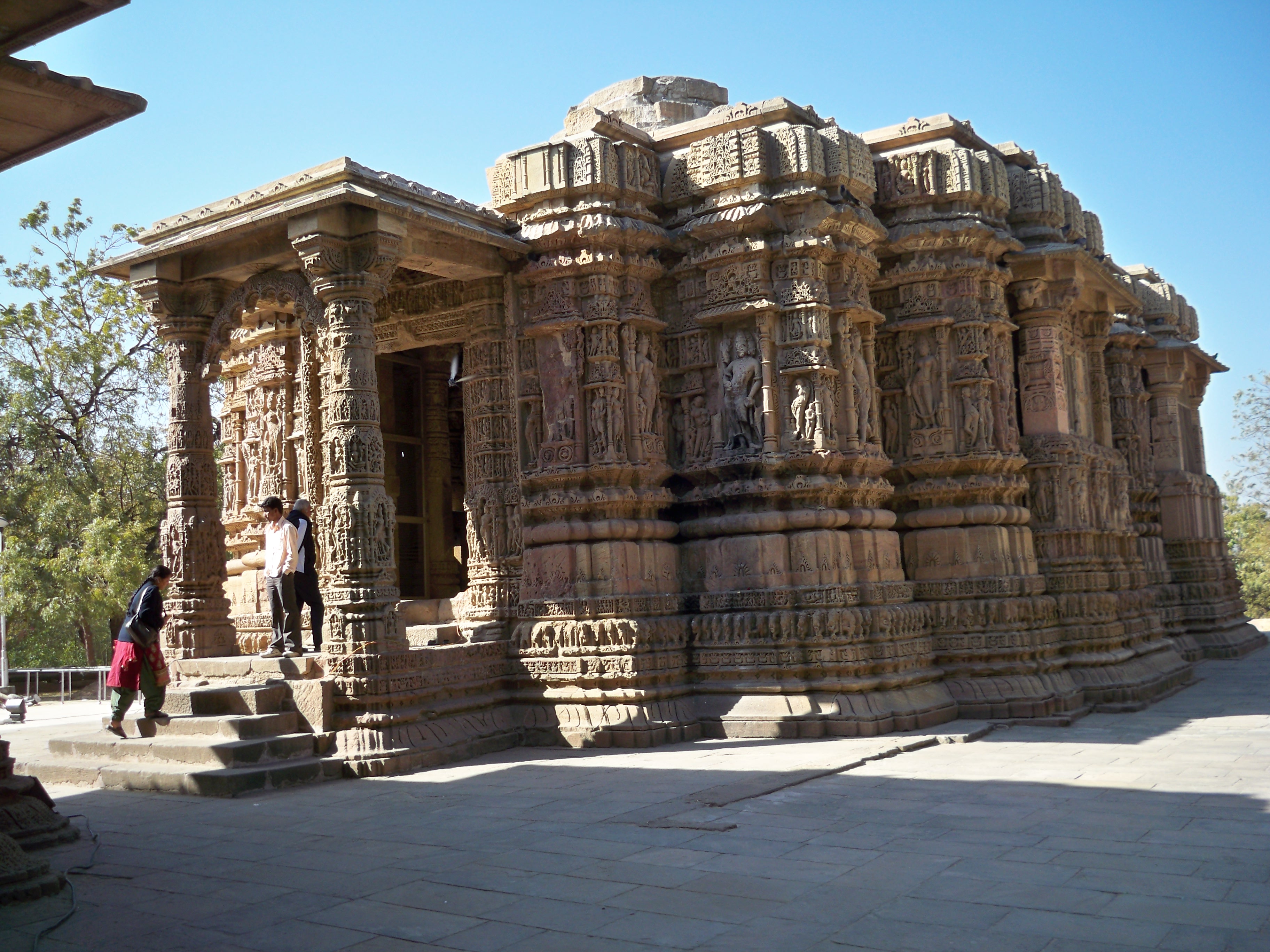
The picture on my first entry was taken on our visit to this temple constructed in 1026 AD. It is not at present a place of prayer and worship which we knew immediately because we weren’t instructed to remove our shoes. It is listed now by UNESCO, a department of the UN, as a ” World Heritage Site.” We visited on a Sunday, as did many groups of school children on field trips to historical sites. These girls were in the 9th form, which I think is 9th grade.
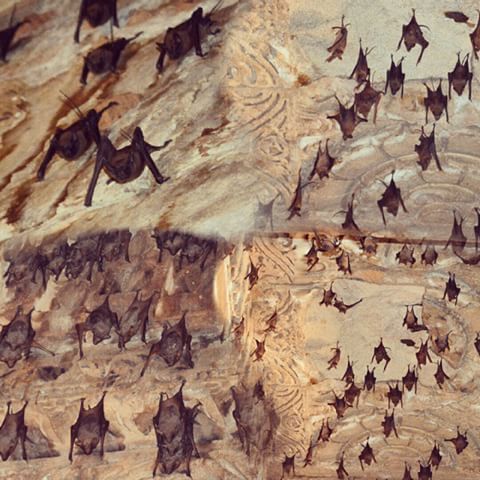
I want to connect this for my former ancient civilization students to our study of Egypt and the sun god RA. Remember we talked about ancient Egyptians worshiping nature, and explaining the movement of the sun across the sky as Ra riding across the heavens in a chariot? The Indian myths describes the sun god, Surya, as “entering this temple each morning,and filling the place with the warmth of his first rays.” Spectacular sight as are hundreds of bats perching inside the domes of the temples. I was glad it was daytime, and they were sleeping.
Bats perching in the dome !
I will be visiting lots of temples during this trip. India is considered the most “spiritual country” on earth. It is the birthplace of Buddhism which spread to the Far East, but now is experiencing a renewal in India. Currently, the major religions are Hindu, the largest, Jain, an off-shoot of Hinduism, Islam, Christianity, Sikhism, and Judaism. The people of India almost universally profess some faith system. In Ahmedabad, there are 17 churches which surprised us. Most practicing Christians live in the South. There was one church listed on the net that advertised a 8;30 English service. After riding in a rickshaw quite a distance, waiting for 40 minutes, no one came. Finally some men said there was no service that Sunday morning! Oh well, T I I……This Is India. ……..
Saturday night. I had a bit of nostalgia seeing and more importantly hearing these giants of my teenage years. I loved Peter, Paul , and Mary. . . then and now. They are folk singers and along with Mary Travers. Sadly Mary is gone, lost to cancer a few years ago, but the guys are still singing ever so clearly and sweetly accompanied only by acoustic guitars. Folk music is known a force for civil rights, social , cultural , and political force just as the marches and protests.
Interesting that today, after 50 years there are still wars and injustice in the world with marches and demonstrations. The popular music is different but there are still themes of anti-war, pro-justice for all, and anti-bullying !
The audience sang every word of every song and applauding enthusiastically. Remembering long ago and far away when we were young. . . . . . . . . . was all good!
Disillusioned with the intelligence community, top contractor Edward Snowden (Joseph Gordon-Levitt) leaves his job at the National Security Agency. He had formally been a member of the United States military and had stellar computer skills with a formidable intellect. He now knows that a virtual mountain of data is being assembled to track all forms of digital communication — not just from foreign governments and terrorist groups, but from ordinary Americans. When Snowden decides to leak this classified information, he becomes a traitor to some, a hero to others and a fugitive from the law.
We enjoyed Oliver Stone’s film. He is an accomplished storyteller. The movie is well written , acted , and directed with suspense, espionage. romance and relationships. For me it was a discovery to learn of Snowden’s military service and very high intellect. Oliver Stone is a talented director but you must always remember that sometimes it is difficult to know if it is true or merely fiction added to promote the director’s agenda.
The film is well worth the money for an entertaining afternoon or evening.
Yesterday, after the funeral of PM Peres in Israel, President Obama is impatient to get on the way home. Former President Clinton, who had been invited to return to the US on Air Force One, just couldn’t drag himself away from the crowd!
My Indian filmmaker friend Chandresh Bhatt messaged me last night with this news. We were surprised that it had not been more visible in the news here. Yesterday, the news was about the horrendous train derailment and the unorthodox presidential campaign.
When we were in India, there was tension and some attacks and beheadings of Indian soldiers on the border. While foreign visitors to India for student or work visas have a 2 week timetable to register with the police, Pakistani people must go to register within 24 hours of arrival.
And who can forget the sneak attack in Mumbai by Pakistani terrorists in 2008? The full film is on Youtube for anyone who is interested. It is in Hindi but the story of bloodshed and pain is clear especially for those of us who survived 9/11/01.
It seems that the worst wars and acts of hatred are between relatives. . . . India/Pakistan, Irish/ English, Israelis/ Palestinians. Wealth and power appear to be the root of war struggles and the ordinary people of both sides are the ones who suffer the most.
This is not a blanket condemnation of Pakistani people. I know and love some very peaceful and kind people from Pakistan. Just as there are some very evil Indian people. Sadly, this is the human condition, in my opinion.
One ray of hope this morning shone in Jerusalem where many world leaders came to honor the great Prime Minister Perez at his funeral. President Abbas of the Hummas government of Palestine, shook hands and spoke briefly to PM Netanyah of Israel.
WORLD
India-Pakistan War Timeline: Recent Deadly Attacks Are Just The Latest Between Nuclear Neighbors
BY JASON LE MIERE @JASONLEMIERE ON 09/29/16 AT 11:34 AM
CLOSE International Business Times
India Carries Out Surgical Strikes In Pakistani Territory
A rising of tensions between India and Pakistan in recent days has led to fears the two neighboring nuclear powers could be heading down a dangerous path to further conflict. Militants who India claims had links to Pakistan attacked an army base in the Indian-controlled region of contested Kashmir last week, killing at least 17 in the deadliest attack on security forces in the area in almost two decades. India retaliated Thursday, carrying out “surgical strikes” on Pakistani-administered Kashmir, claiming to have caused “significant casualties to terrorists.”
While Pakistan downplayed the attacks, the war of words and, more perhaps worryingly, actions continue over the Himalayan region that has been at the heart of three wars between the two countries over the past 69 years.
Below is a timeline of the events that preceded the latest conflict between the two countries:
India-Pakistan conflict Kashmir
Indian government forces detain a supporter of, Engineer Abdul Rashid of Awami Ithaad Party, a pro-Indian political party, during a protest march towards the United Nations Military Observer Group in India and Pakistan to protest against the recent killings of civilians by Indian government forces, Sept. 26, 2016. Photo: Getty Images
1947-1948 – India’s independence from Great Britain after World War II saw the ruler of the princely state of Kashmir, comprised of a majority Muslim population, tasked with deciding which of the newly created independent states to join – India or Pakistan. An attack by Muslim tribesmen in October 1947 prompted Maharaja Hari Singh to seek assistance from India and later to sign an Instrument of Accession, ceding Kashmir to India.
That led to the start of the first war over the region, which was only halted Jan. 1, 1949, when a United Nations-brokered ceasefire created a line of division that gave India control of 65 percent of the territory and the remainder to Pakistan. Intended to only be a temporary arrangement until a referendum was held, the division remains in place to this day.
1957 – India declared Kashmir an integral part of the Indian Union.
1965 – An April clash between border controls in Kashmir precipitated a covert operation by Pakistan into India-controlled territory. India followed by invading Pakistan along the country’s Lahore border, leading to the second Indo-Pakistani war. After three weeks of warfare, the two countries agreed to a UN-sponsored ceasefire and signed a declaration the following January to settle their disputes by peaceful means.
FindTheData | Graphiq 1971 – India and Pakistan went to war for a third time, but it was the first time the conflict did not involve Kashmir. In that instance, a civil war between the West Pakistan army and East Pakistanis demanding independence sparked conflict. After the Pakistan army tried to halt the uprising, India intervened with an assault against East Pakistan. More than 90,000 members of the Pakistani army became prisoners of war after the end of the 13-day conflict which led to East Pakistan becoming the independent country of Bangladesh Dec. 6, 1971. The following year, India and Pakistan signed the Simla Agreement, exchanging the withdrawal of troops for the release of prisoners of war and attempting to set a blueprint for future peaceful relations.
1989 – Armed resistance to Indian rule in the Kashmir valley commenced as Muslim political parties, claiming state elections in 1987 were rigged, formed militant wings. Pakistan offered the insurgency its “moral and diplomatic” support, while India claimed Pakistan was providing weapons and training. New militant groups would continue to emerge throughout the 1990s.
1999 – Shortly after both countries conducted nuclear tests, then-Indian Prime Minister Atal Bihari Vajpayee and his Pakistani counterpart Nawaz Sharif signed the Lahore Declaration, reaffirming the Simla Agreement. However, just a few months later the two now nuclear powers would be engaged in conflict once again. The Kargil War started when India launched air strikes against Pakistan-backed forces which had crossed over to the Indian side of the Kashmir border. Tens of thousands of civilians on both sides of the border became refugees before Sharif ordered the withdrawal of the infiltrating forces.
2001 – An attack on the Indian Kashmiri assembly in Srinagar, which killed 38, was followed by an armed attack on the Indian parliament in New Delhi, killing 14 more. India continued to condemn Pakistan for cross-border terrorism before Pakistan President Perez Musharaf promised to counter extremism on the country’s own soil.
2007 – The day before talks were due between the two governments, a train operating between India and Pakistan was bombed, killing 68 people, mostly Pakistanis. Both countries’ governments condemned the attack but nobody was convicted for it.
2008 – Armed gunmen opened fire on civilians across the Indian city of Mumbai Nov. 26. More than 160 people were killed. Though Pakistan denied involvement or knowledge of the attack, India broke off peace talks.
2010 – Protests by Muslims in Indian-controlled Kashmir led to a crackdown by Indian forces, leaving 120 people, mostly youths, dead.
2016 – A calming of relations in Kashmir was fractured after a July killing of a 22-year-old separatist militant named Burhan Muzaffar Wani by Indian security forces.
World
One of India’s most-populous states recently banned alcohol. Mayhem ensued.
Praveen Kumar, in a white sleeveless vest, says he is too afraid to a drink since prohibition started in April. His wife, Sumedhi Kumar, is part of a women’s liquor squad that reports — or even beats up — men who are found drinking liquor. ( Rama Lakshmi/TheWashington Post)
By Rama Lakshmi September 24 at 3:30 AM
KHANPUR, India — For decades, this riverside hamlet of lower-caste Indians made liquor for a living by fermenting the fruit of the mahua tree, but since a strict prohibition was imposed in Bihar state in April, police have begun raiding homes, chasing away drinkers and arresting villagers.
In response, the village vowed to give up its main source of income and poured 200 gallons of freshly made hooch into the river in a public declaration of defeat.
“Now where do we go, what do we do? Our money and food will not last long,” said Jagar Rajvanshi, 60, a balding and spectacled man in a blue sarong who had been producing alcohol for years.
[Indians are rioting over water. Is this a glimpse into the future?]
Alcohol is not illegal in predominantly Hindu India, but there has long been a social stigma against it in this conservative country, and state-level bans have become a popular ploy for politicians in India anxious to secure the women’s vote.
Village elders read out news about prohibition’s strict rules and news about recent raids and arrests to the men in the Simrauka village. Praveen Kumar, middle, says he wants to drink but is too afraid to do so because of the strict laws. ( Rama Lakshmi/The Washington Post)
Drinking is on the increase in India, with rising middle-class affluence, a youth bulge and increased opportunities to dine out. According to a report by the Paris-based Organization for Economic Cooperation and Development last year, India ranked third on a list of 40 nations in terms of rising alcohol consumption between 1992 and 2012.
At the same time, rural female voters are becoming more assertive about the depredations of alcoholic husbands, and this has become a potent election issue.
The southern state of Kerala has begun a phased ban, and neighboring Tamil Nadu is contemplating introducing such a prohibition again after a lapse of several years.
But the man who has made the issue his own is the chief minister of Bihar, Nitish Kumar, who instituted the controversial ban after an election-year promise to women voters who complained about their drunken husbands.
But prohibition has brought unintended consequences — much as the United States found out almost a century ago — and now thousands are in jail, liquor smuggling has exploded and vigilantism is on the rise.
The anti-alcohol campaign has sent more than 14,000 people to jail since April in a state where the prisons were already overcrowded. More than 43,000 gallons of alcohol have been seized and thousands of shops shuttered. Those caught consuming alcohol can face 10 years in prison, and bail can take weeks.
Anup Kumar sells toddy on the streets of Bihar. The largely poor northern state has one of the toughest prohibition laws, setting off panic among people. ( Rama Lakshmi/The Washington Post)
But what has set off panic among residents are the draconian provisions in the law, including a clause whereby all adults in a family are now accountable if one member drinks. Homeowners can be arrested if a tenant is drinking, and the entire village can be fined if liquor is made there.
“We are not opposing prohibition, but we are saying it is unimplementable in the 21st century,” said Sushil Modi, opposition leader from the Bharatiya Janata Party in Bihar. “There is a climate of fear everywhere.”
Over the years, Kumar has carefully constructed an image as a politician who listens keenly to women voters. His government provided free bicycles to young girls to encourage them to attend school. He set aside government job quotas for women and promoted village self-help groups.
His proposal for an alcohol ban came against a backdrop of the real suffering by some wives at the hands of their husbands.
“My husband spent all the wages on alcohol. If I said something, he would throw things around in anger and hit me. He would say, ‘Who are you to question me?’ ” Sumedhi Kumar, 35, recalled.
[She was raped at 13. Her case has been in India’s courts for 11 years — and counting.]
So after he came to power for his third term — when he trounced Prime Minister Narendra Modi’s party in the state — Kumar announced a total prohibition. He did so with the full support of local women’s groups, who have since formed squads to enforce the ban, reminiscent of Carry Nation’s temperance movement before the period of prohibition in the United States.
“We now beat up men who dare to drink, with sticks and brooms. Women have become the liquor police,” said Sunaina Prasad, 45, in Simrauka village.
It is interesting to anticipate what will happen in India with this prohibition. When we were in India, we were headquartered in Gujurat where Prime Minister Modi was the Chief Minister. Gujurat was a dry state , though the students found some way around that, as students are want to do !




 David and the students completed the hike, both up and down with their handy Ghandi bamboo sticks. I tried, giving it my best, with my trusty stick. There were carriers who work in pairs or double pairs carrying those who are unable to walk either to the top or the bottom. I didn’t want to think I needed carrying either because of my age or health. On the way up, I struggled about halfway walking and resting, and catching my breath. I was asked repeatedly if I wished to be carried and I would reply, “No thank you.” When my chest started to tighten up, I relented and ignored my pride. It was not worth having a heart attack on a mountain in Gujurat!





 TalesAlongTheWay