TIHAR jail in Delhi has a special wing just for her. Young women fear and revere her; their husbands seem crushed by her embrace. On television she is a sari-clad battle-axe. Books about her offer advice including: “Run, she is trying to kill you.”
If you think the fearsome reputation of the Indian saas is exaggerated, glance at online discussion threads such as “I have a mother-in-law from hell”. Tales abound of humiliation, intrusion, even death threats, amid battles over who controls family life. Or watch what was formerly India’s most popular soap opera, the clunky title of which doubled as a plot summary: “Because the mother-in-law was once a daughter-in-law too” (“Kyunki Saas Bhi Kabhi Bahu
“The longest-running, biggest grossing serial in India”, as Smriti Irani, its star, describes it, focused on how a mother-in-law managed the young women who entered her life. Mrs Irani’s fame propelled her into politics, where she speaks on women’s issues for the opposition. The show itself spawned imitators that now constitute a whole genre, known assaas—bahu (mother-in-law—daughter-in-law). It accounts for roughly half of the 50-odd Hindi-language soaps now running. Dozens of similar dramas are broadcast in Bengali, Gujarati, Marathi, Punjabi and Tamil.
Mrs Irani says viewers tuned in for eight years until 2008 because the programme depicted lifelike family clashes. The real-life battles continue, but, as Indian society evolves, the outcomes and the roles are changing.
Of course, mothers-in-law are demonised and ridiculed all over the world. But India is different, in two important ways. First, whereas in the West the jokes and grumbles tend to emanate from men, in India the crucial relationship is between a wife and her husband’s mother. That is because young women traditionally move in with the groom’s relatives after marriage, to be fed, housed and subsumed by them. Second—and although the sprawling Indian family can seem enviably intimate and supportive to outsiders—the subsequent problems are often more tragic than comic. For many women newly shunted into a stranger’s household, life can be utterly miserable.
The explanation lies in the once isolated villages that in the past were home to the vast majority of Indians, and in which two-thirds still live. Traditionally, village girls wed young. As late as the 1960s they married on average at just 16; brides as young as five were not unusual in states such as Rajasthan. For these youngsters, a mother-in-law could be a sort of stepmother, raising and protecting them, teaching them to toil, helping them to decide when to have children themselves.
But the tutelage could easily tip over into abuse. The bride often arrived as little more than a skivvy; arranged matches with strangers could leave her especially unprotected. Couples were strictly policed. Even a happy pair were not supposed to show it: touching (forget kissing) or even speaking together in front of older relatives was taboo. A saasmight even control whether the couple could have sex, by making the younger woman work late and rise early. The point was to stop her son bonding with his wife.
An elderly woman in north India, laughing ruefully, recalls how, after her rural wedding, it took “three days to work out which man in the new family was my husband”. Even today, some honeymooning couples take along the saas. A woman in Delhi says that, when her Bengali mother-in-law visits, she insists on sleeping in the marital bed with her son; the wife budges over, or decamps to a sofa.
The mother-in-law syndrome reflects the skewed power relations between the sexes, as well as strife between the generations. The imbalance begins at (or before) birth. Even today, girls are likelier than boys to die in childhood; they often receive less food, schooling or medical care, or are simply abandoned. This is largely because males still wield economic power. Boys generally inherit land and other assets, and are far likelier to bring home wages. Girls are passed to other families as wives and domestic labour.
Since men control a family’s dealings with the outside world, running the farm or a business, women are left to oversee the home. The legendary ferocity of the saas can be seen as an effort to monopolise the little power that is available to her sex. Rekha Nigam, a screenplay writer and television boss in Mumbai, suggests that enforcing order in the family is a mother-in-law’s way of aligning herself “on the side of patriarchy”. That often meant, and means, older women tormenting younger ones.
Consider the saas’s role in the starkest symbol of women’s low status: dowry, the practice of a bride’s family paying the husband’s money, jewellery or other assets to take her off their hands. The practice is now illegal but persists—and violence is often involved, when promises are unmet or recipients demand more.
It is not a small problem. Last year over 8,200 women were murdered over dowry, over half of them in three northern states: Bihar, Uttar Pradesh and Madhya Pradesh. In May this year India’s Supreme Court warned of “an emotional numbness in society”, whereby daughters-in-law are kept as near slaves or attacked out of “insatiable greed”. Brothers, cousins, even the husbands themselves, sometimes carry out the attacks. But the mother-in-law is often held responsible.
By tradition, a wife accepted her saas’s tyranny. The life of Renubala, now an elderly woman, is typical. Married at “12 or 13”, she moved in with her husband’s farming family in Tripura, in north-east India. For three years she shared a bed not with him but with his widowed mother. “I was very scared of my mother-in-law, even when she was nice,” she remembers. “I would call her ‘ma-goshai’ [Godmother].”
Renubala would rise at 4am, prepare a hookah for her shashuri (the Bengali equivalent of saas), then fetch water and clean the house. “I worshipped her as a goddess,” she recalls. “After she had taken her bath, I would wash her clothes, massage her head and body, tie her hair. Whenever she came in sight I would bend and touch her feet to show respect.” Utter submission brought benefits, she remembers: order in the family; stern guidance.
Since divorce was taboo in much of India until the past couple of decades, and paid female employment was rare, women such as her had few alternatives when stuck inside an unhappy family. Grumbling to your own parents was frowned on, especially if they had paid to be rid of you.
Still mummy’s boys
These traditions live on, sometimes in unexpected places. In 2014 Veena Venugopal will publish “Mother-in-law: The Other Woman in Your Marriage”, a book in which she recounts 11 cases of urban, English-speaking women made miserable by their mummyjis (a term popular in Punjab). She had intended to write a funny book, but each of her dozens of preliminary interviews revealed a bride repressed by older women. “It was depressing, to be honest,” she says. She blames the “unhealthy” joint Indian family.
One fabulously rich family in Mumbai, whose matriarch wears “diamonds the size of birds’ eggs”, feuded for years over who controlled the servants. Separate meals were forbidden, lest rumours spread of division in the family-run business. Eventually the daughter-in-law fled. In Kolkata a woman who married into an apparently liberal joint family was banned from working outside the home. Her saas insisted on picking her wardrobe.
Mrs Venugopal sees sex and shame behind such obsessive control. Mothers-in-law, she says, “don’t trust [daughters-in-law] to be faithful”, so they try to desexualise them, locking them up, fattening them up, phoning several times a day. True-life horror stories endorse that interpretation. In 2007 a Sikh grandmother was jailed in Britain for 20 years for the murder of her daughter-in-law during a trip to India. The younger woman had fallen pregnant by another man.
These days assertive mothers seem equally intent on controlling their sons. “Mothers never cut the son’s umbilical cord,” jokes a Canadian married to a Kashmiri man. Sons can seem cosseted, even crushed, dutifully caring for elderly parents and occasionally handing their salaries to their mothers. (Among Hindus a son lights the funeral pyre to speed a parent’s trip to heaven.) A Bengali wedding ceremony still requires the groom to tell his mother: “I will bring you a servant.” The burdensome bride informs her own mother: “Your debt is cleared.”
One man in Uttar Pradesh, whose wife and mother live in Rajasthan, says he phones his mother four times a day, his wife of 16 years only once. His wages go to the mother. “My wife at first wasn’t happy, but now she is OK, her mind is more patient,” he explains. Mrs Nigam, the screenwriter, says that “the son is treated as the spoils of war” by his mother and wife. “A boy is mollycoddled, pampered beyond belief, made to think the sun shines out of his backside. He gets a terrible sense of entitlement.” In popular culture, she says, the only woman a man looks up to is “his mother, the woman who turned him into the asshole that he is”.
The bahu strikes back
When the women clash, tradition makes clear where male loyalty lies
Sons rarely grumble—why would they? Anyway, a rigid family structure fixes roles for men too. When the women clash, tradition makes clear where male loyalty lies, says Mrs Nigam: “It would be very, very disrespectful to take the wife’s side against the mother.” Mrs Venugopal relates the tale of a man caught between his Austrian wife and Indian mother. The women live on the same street, so he sleeps at his wife’s flat, “but has to walk back to his mother’s house to brush his teeth in the morning”.
The soap-opera sagas of the domineering, conservative saas battling her prettier bahu over food, clothes, men, children and money appeal because such clashes are widespread. On screen the younger woman mostly submits. Mrs Venugopal worries about the message that sends. Such programmes “offer terrible examples of how to behave”, she says; “the most abused women I met were the most hooked on the TV shows.”
Yet despite the persistence, in some places, of the old pattern—including in some prosperous families—in the country as a whole technology, urbanisation and education are changing saas-bahu relations, just as they are transforming much of Indian society. In 1951 just 9% of women could read even a word or two; today two-thirds can. The educated expect to keep working after marriage; divorce rates are rising. Many women are rejecting sindoor, vermilion worn in the hair to signify devotion to a husband. And the bahu is beginning to strike back.
To observe that shift in practice, visit Hatfield private detective agency, one of about 50 such outfits in Delhi. It was founded in 1991 by Ajit Singh, a man with a Poirot-thin moustache. Mr Singh has placed comical props around his office: a black Trilby and dark glasses, Sherlock Holmes paraphernalia, an oversized magnifying glass.
Business is buoyant, he says, in part because of a busy line in “marital investigations”. (Marriages are still arranged, for the most part, increasingly online.) Mr Singh charges 20,000 rupees ($323) to double-check a potential daughter-in-law’s family background, reputation and employment. For 300,000 rupees some of his 50 staff will chat up servants at her house, pose as financial investigators, call old friends and trail her. The most important question is whether she is gharelu, “homely”, meaning subservient, timid, hard-working.
Strikingly, his customers now include rising numbers of brides (and their parents), too. “The majority of the girls have a very high expectation of marriage—and it doesn’t meet reality,” says the detective. These clients ask of the groom’s mother: “Is she God-fearing, quarrelsome, friendly with the neighbours, how does she deal with the maid, is she going to temple, does she spend all day in the markets, at kitties [parties], and is there any drinking? Because the girl is going to marry that house, she is going to spend a lot of time with that lady.”
Brides have become more assertive: “Twenty years back the majority of girls were dependent, but now they work,” Mr Singh observes. “They don’t tolerate the bullshit. It has become very tough to be a mother-in-law now.” Women also hire him after marriage, he says, amid rows over family finances, to learn what assets are at stake. He tells of a saaswhom his team followed daily, to chronicle the parties and clubs she attended and the money she spent. “The daughter-in-law wants to know her weak points,” he says, chuckling.
Young women are also better protected by the law, at least in theory. Neena Dhulia, of the All India Mother-in-Law Protection Forum, fumes that 15 recent laws relating to women (on dowries, domestic violence and so on) amount to a licence for “an intolerant young generation of women” to destroy families. “The mother-in-law is the main target and is referred to as a demon or a monster,” she complains.
Mrs Dhulia’s organisation was founded in 2009, with the aim of defending the traditional extended family. She sees a conspiracy by official bodies such as the National Commission for Women to “break the Indian families; every government department is involved in this extortion.” In protest, her members won’t celebrate Independence Day onAugust 15th, drinking only sugarless tea “because we feel the Indian husband’s family is still shackled.” According to Mrs Dhulia, “The main problem is that today’s women are educated, but not in the proper way. Parents are incapable of teaching the daughter how to stay in her in-laws’ house.”
But should young wives simply endure abuse? Mrs Dhulia retorts with a Hindi saying: “once you go to your in-laws’ house, only your dead body should come out.” Too often, this is still literally true. Among 12,000 prisoners at Delhi’s sprawling Tihar jail, a portion of female inmates are kept in a dedicated, barracks-like “mother-in-law wing”. “Most of the time the women say they acted in a fit of anger,” says a spokesman. Their victims are daughters-in-law—beaten, ill-treated as menial servants or assaulted over dowries.
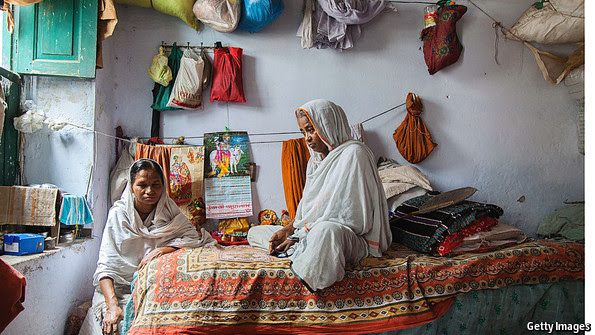
In modern India, however, it is often mothers-in-law like Mrs Dhulia who feel aggrieved. Maitri, a charity, helps destitute widows in Vrindavan, a town crammed with devotees of Krishna and backpackers searching for weed and their souls. Its clients queue up to berate their daughters-in-law. One says tearfully that her bahu broke her leg. “Brides arrive in the house prepared, they can’t be abused, they do the abuse,” she laments. Another says her worst mistake was picking an educated woman as her son’s wife.
Saasy no more
Among these unfortunates is Renubala, the woman who, as a bride in Tripura, had worshipped her own mother-in-law as a goddess. Her life straddled the transformation of Indian families and society, and she wound up suffering again when she became a saas herself. Sitting on the floor, she wipes a metal plate with the end of a grubby sari and calls her bahu a “tigress”. The younger woman was 30 at marriage (the average for Indian women is now up to 21). Renubala says she was denied food, prevented from speaking to her son, suffering abuse and violence.
In the end, she says, her son told her he was taking her on holiday, only to abandon her in Vrindavan, 1,400km from home. With a smear of mud on her forehead she now begs for alms, singing devotional songs and reciting the 108 names of Krishna. Her son won’t light her pyre, she accepts, though she sends him what she gets by begging. Asked to explain the changing fortunes of mothers-in-law in India, she says: “we are living in the time of Kali Yuga”, a mythical era of strife, when human life is only lust, greed, broken vows and violence.
The time of Kali Yuga
The rising concrete is unmistakably for nuclear, not extended, families
The tide is in the bahu’s favour. For further tangible evidence of that, drive out on the swanky new highway that whizzes tourists from Delhi to Agra and the Taj Mahal. On either side of the road stand the shells of half-built residential blocks. They contain flats with two or three bedrooms—space enough for a couple and a baby. The rising concrete is unmistakably for nuclear, not extended, families. A census in 2011 confirmed this trend: it found that only 18% of households contain more than one married couple, a share that is falling a few percentage points every decade.
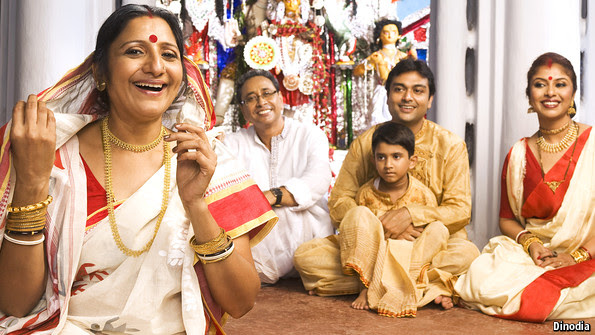
Still, the struggle is far from over. The best time to observe saas and bah u together in public is Dhanteras, a part of the Diwali festival, when Hindus celebrate Lakshmi, the goddess of wealth. Families shop together for gold and jewellery. This year at Dhanteras, Rama Krishna Jewellers in Delhi is busy. Customers cram through a gate of flowers. One family studies earrings, the mother-in-law explaining an annual habit of buying something for her bahu.
Relations are good in their joint family, not like the “exaggerations” on TV, the older woman says. “We love to watch them, but know they are not like reality,” she explains. “Am I like a wicked TV mother-in-law?” she asks her plump, pretty daughter-in-law. The younger woman smiles, lowers her eyes, and says “No.”
What do you think? Are there other stories or experiences out there? Any different stories of Indian mothers-in-laws? Do you know of some loving mothers-in-laws?
Thanks to my friend , Judith for the article.

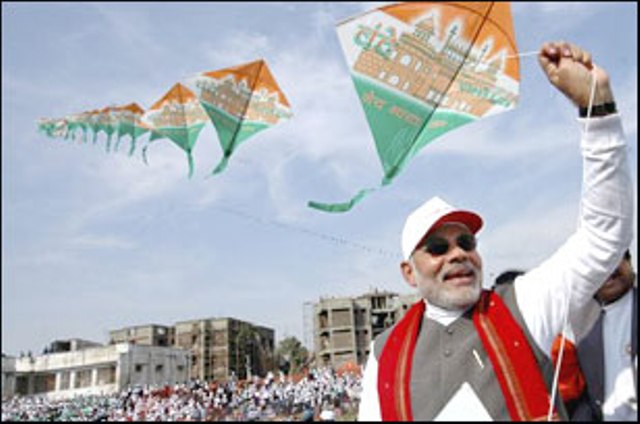
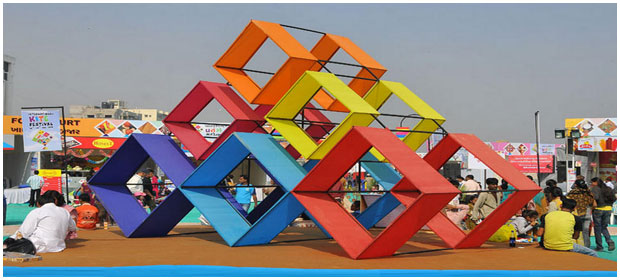
 Colorful tissue paper kites were being sold everywhere in Ahmedabad soon after we arrived. The anticipation of the two day holiday, January 14-15, was building.
 Little boys dream of the day they, too, will be in the competition.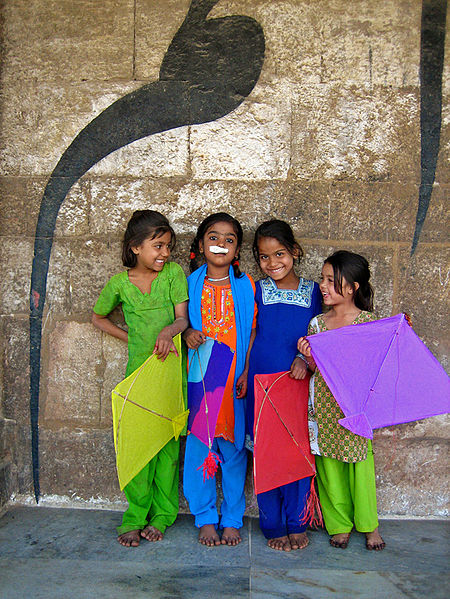


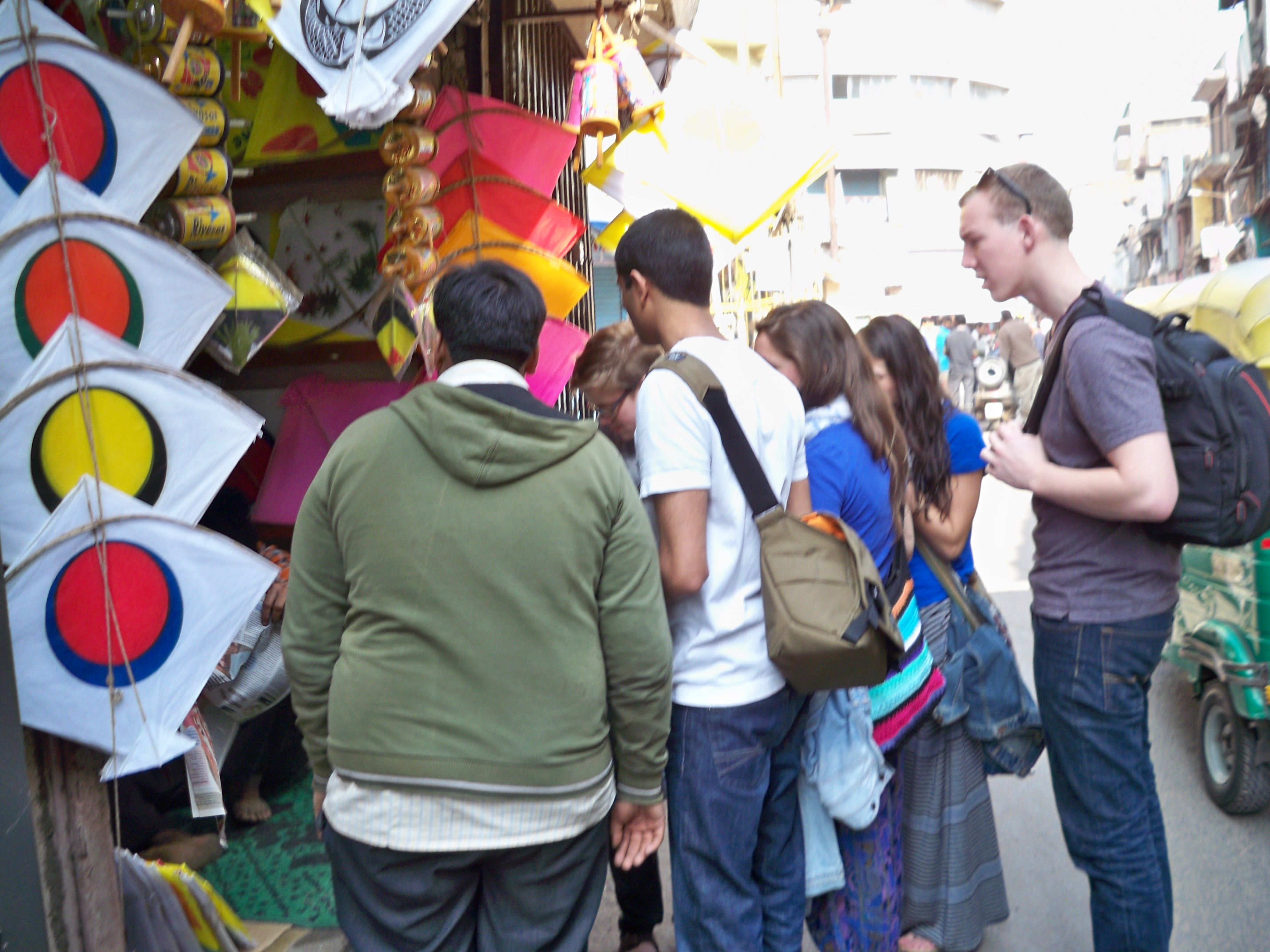 This is our group buying kites in the old town bazaar.


















 It is a snowy scene at the University of Alaska Fairbanks after a storm hit the region. (Original Photo/Austin Cross)


 TalesAlongTheWay