Feral Dogs

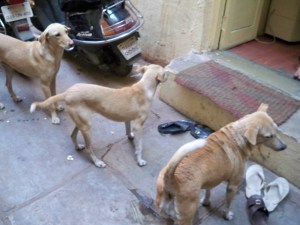
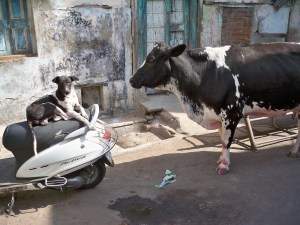
100_2827  They come in various colors, white, a ginger  brown, black, and  mixtures of the three. A few have long coats and all have pointed  snouts. And they are not pets, or so we thought. The dogs live in the street scrounging in the sweeping piles and  jumping with strong legs to scale a low fence for a morsel. They are “hunters and maybe gatherers,” just trying to survive. Their ribs show prominently through their skin and they are caked with mud. The Indians ignore the dogs except if there is a fight between the males for territorial rights. Then they yell and wave their hands.

The picture shows Ginger and Burnt Marshmallow with one of the puppies in front of our hostel. They live and control a pack of several females and various puppies in our lane. They rarely venture out into the busy street at the end of our road, but they”work” every morning trotting, one on each side, as our guards, as we walk to the end of their territory. They don’t run and jump up on us, or bark or demand any attention whatsoever. We are in parallel universes. As we head to the rickshaw stand, our dogs snarl and bark ferociously at the pack across Samved Hospital Road. (Yes, a city of 5-6 million has unnamed streets.) I sent these pictures to my friend Donna who taught at an International School in Egypt. To my surprise, she said the Indian dogs are cousins to the Egyptian ones and look the same.  Packs roam the village streets and into the desert in Egypt and they are killed by the Egyptians. This is probably the case because dogs are considered unclean in Islam.  Bowls of milk are left outside for feral cats. Student alert: Remember when we talked about the ancient Egyptians worshiping cats, especially the hairless cat? There is even a cat mummy in the Albany Institute of Art. It seems that five thousand years later, cats are still revered in Egypt.

On the a fore mentioned street known as Samved Hospital Road, we made an Indian friend. We were walking to a favorite restaurant when half a dozen dogs scooted in and out of traffic to reach a man standing on the sidewalk. This was Sunil, a social worker in Ahmedabad. He has adopted this pack of dogs, taking them to a veterinarian for neutering and vaccinations; plus, he regularly feeds them with scraps and bread crusts. Laughing, he commented, “The dogs know my license plate, so they come.” One Indian trying to do what he can by entering, if only momentarily, the canine universe of the city streets.

David and I have resisted touching our guard dogs or the ones at the University until last week. The first time was a quick pat on a dog’s head, followed by a big dog smile. Next, I started calling them by the names I had chosen for them, Burnt Marshmallow, and Ginger. They respond with a vigorous wag. Could they understand English? Oh, it must be my  tone. The students have been placing their left-overs on the trash piles for sometime. It seems we have dog friends in Ahmedabad.

The most touching feral dog story happened on our first trip to the old city market which was filled with teaming masses, wonderful sights, smells, and sounds. As we wandered in and out of ancient streets looking side to side, trying not to miss a thing, something caught my eye at the end of a street next to a display of flowing, vibrant scarves. There was a low table with a very old dog lying on the top. He was stretched out, eyes closed, and his legs straight out. He appeared to not be breathing. Next to him was an elderly Indian, standing quite still, looking down. Now, the dog could have been sleeping there, I guess, but this is not a usual sight. To my mind, the man had placed the old dog on the table for a more comfortable passing, and he was standing next to his friend in order to be with him to the end. I understood as I, too, have loved and lost a very special dog friend.

Nameste!  T I I…..
100_2842100_2900

Posted in India, Uncategorized | Tagged | 13 Comments

Books on India

Just in case some of you are interested in  books about  India that I have recently read, today I thought I would share them.  Two are fiction and one is narrative nonfiction.  All are available on  e-books.

Vish Pur Mysteries…a series by Tarquin Hall   I read THE CASE OF THE  DEADLY BUTTER CHICKEN These have  “cases”, recipes, and tales of  Delhi   It is full of descriptions of the humor found in India when you  go with the flow here.  The inspector is the Founder and Manager Director  of  the Most Private Investigation LTD.  and a heck of a cook!    The Vish Puri e-sampler  is free of charge. It catches the spirit and humor of not over-thinking the experience that is India!

BEHIND the BEAUTIFUL FOREVERS: Life, Death, and Hope in a Mumbai under-city  by Katherine Boo  This book was the  National Book Award winner for 2012, as well as the National Book Critics’ Circle Award finalist in the same year. Boo researched  residents of the slum  for five years to tell their stories.   This sum neighborhood has been plowed under so as not to upset the tourists arriving by plane into Mumbai.  Where do slum dwellers live when their boxes and  shacks are plowed under? I found this a riveting read.

THE WHITE TIGER by Aravind Adiga, fiction , winner of the Man Booker Prize in 2008. Unsettling, dark satire exposing the corrupt, feudal society of  “the world’s largest  Democracy”. Uncomfortable and educational for a women who grew100_2923 up in Virginia during the Jim Crowe South. The story is a far cry  from the stories portrayed by Bollywood.  It is  not the story of happy peasants.

I am working on a post about the Feral Dogs all around us here.  Maybe tomorrow……

Enjoy…..This Is India……T I I!


Posted in India, Uncategorized | 7 Comments

Sweeping, Sweeping Everywhere!

In almost six weeks, we  have seen no trash trucks, no recycling bins to be emptied, but endless sweeping , everywhere.  The trash  must go somewhere and that is into piles along the sides of the road. In the mornings, the piles have turned to ashes because the homeless burn the piles for warmth against the chilly desert night. Mumbai allows no burning of the trash piles, consequently the piles are higher there because, of course, they do have sweeping.  Feral dogs and cattle scavenge for morsels deep inside the trash. 

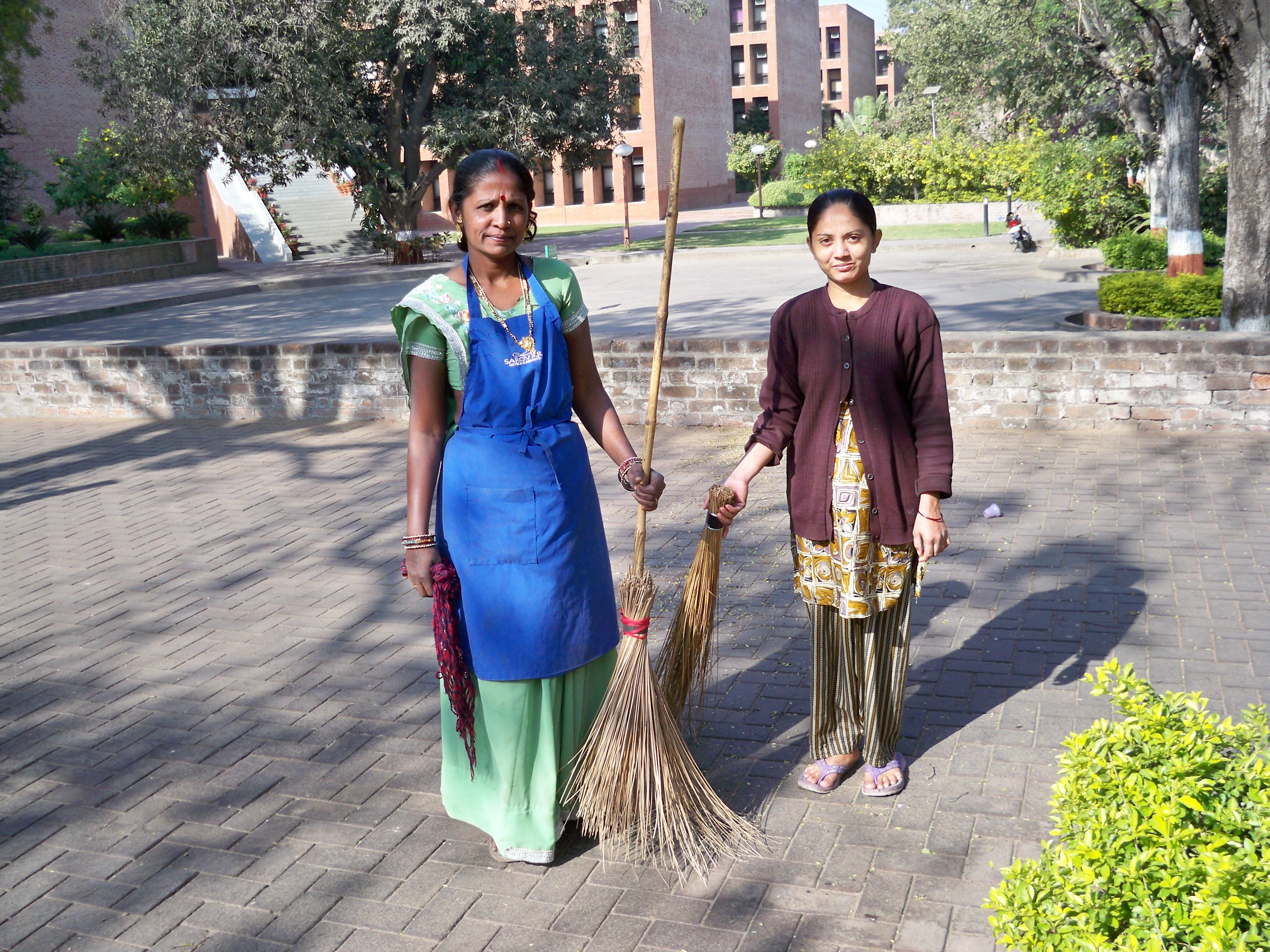
Houses along our unpaved lane, deep in the heart of Ahmedabad, are surprisingly upper middle class. In the  morning, each house has two sweepers and a boy to wipe the  steps and tiles with a rather dirty wet cloth. The pile from each house is swept out onto the lane by women using  these ancient handmade brooms. As far as I know, there are  no social programs in India.  No unemployment insurance, medicare or  medicaid or Social Security. Here there are assistants for every job, and much of it seems to be “make work” for the poor. I have no idea how much the pay is, but many people are paid or fed to complete a task that could be accomplished by many less workers. I read that the wealthy don’t hire a driver or a cook but they hire “servants” who do every job needed by the family.  It seems whole families can be hired by an affluent family .  The poverty slams you in  the face , Nothing like I have seen, except  in Egypt, many years ago. At this moment in time, the lucky ones here from the 1.000,000.000,000 population have,at least , a sweeping job. 

ImageThe women in the picture were sweeping at the Indian Institute of Management, a very beautiful complex designed by Louis Kahn. I tried to take a picture of the woman on the left sweeping, but she insisted that she stand next to her friend. Many Indians love to have their pictures taken and then want to see themselves in the camera. So far no one has asked for a “tip” for taking a picture.  


Posted in India, Uncategorized | 24 Comments

The Sun Temple at Modhera

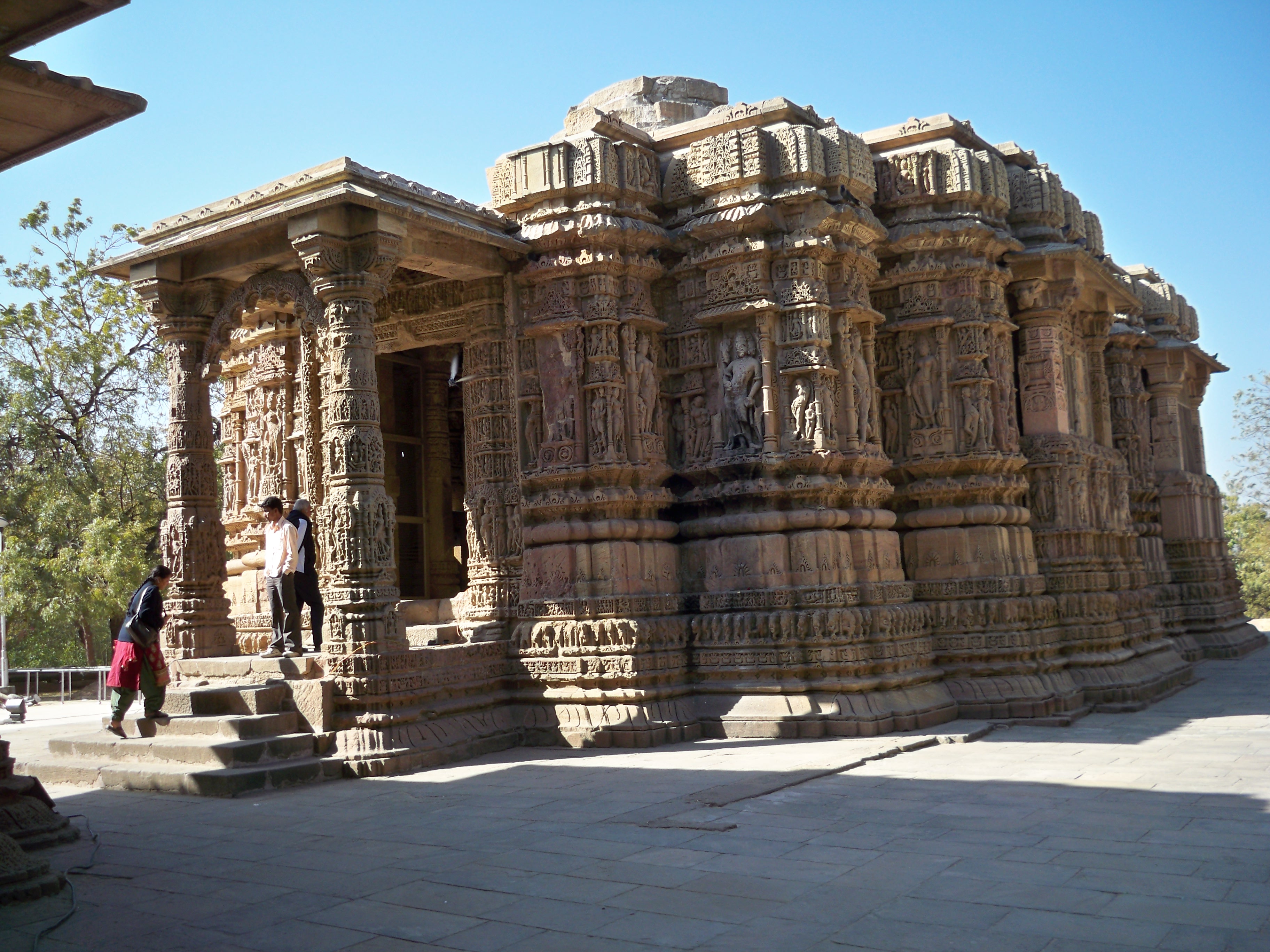
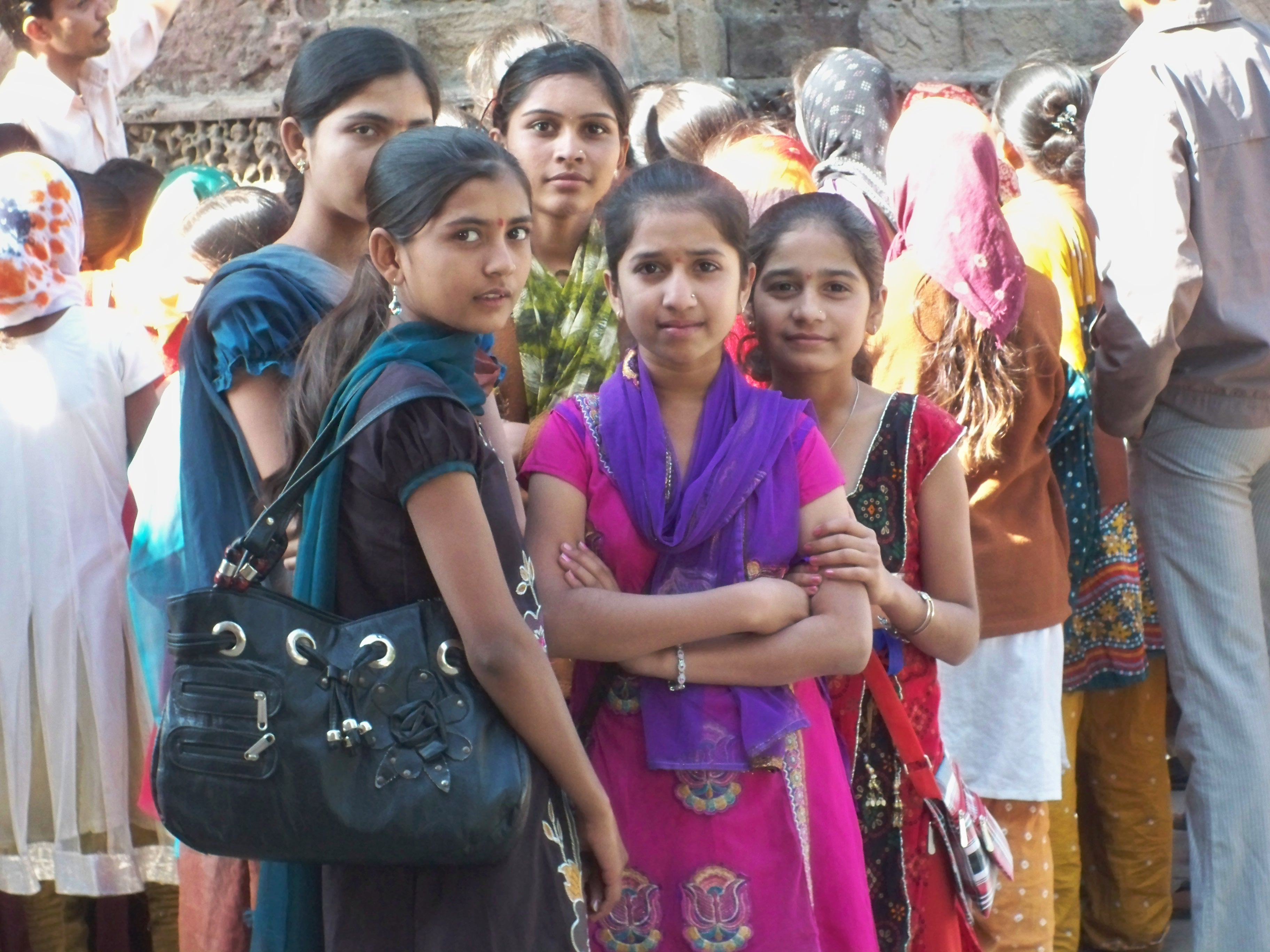
The picture on my first entry was taken on our visit to this temple constructed in 1026 AD. It is not at present a place of prayer and worship which we knew immediately because we weren’t instructed to remove our shoes. It is listed now by UNESCO, a department of the UN, as a ” World Heritage Site.” We visited on a Sunday, as did many groups of school children on field trips to historical sites. These girls were in the 9th form, which I think is 9th grade.

I want to connect this for my former ancient civilization students to our study of Egypt and the sun god RA. Remember we talked about ancient Egyptians worshiping nature, and explaining the movement of the sun across the sky as Ra riding across the heavens in a chariot? The Indian myths describes the sun god, Surya, as “entering this temple each morning,and filling the place with the warmth of his first rays.” Spectacular sight as are hundreds of bats perching inside the domes of the temples. I was glad it was daytime, and they were sleeping.

I will be visiting lots of temples during this trip. India is considered the most “spiritual country” on earth. It is the birthplace of Buddhism which spread to the Far East, but now is experiencing a renewal in India. Currently, the major religions are Hindu, the largest, Jain, an off-shoot of Hinduism, Islam, Christianity, Sikhism, and Judaism. The people of India almost universally profess some faith system. In Ahmedabad, there are 17 churches which surprised us. Most practicing Christians live in the South. There was one church listed on the net that advertised a 8;30 English service. After riding in a rickshaw quite a distance, waiting for 40 minutes, no one came. Finally some men said there was no service that Sunday morning! Oh well, T I I……This Is India. ……..Image

Posted in India, Uncategorized | 8 Comments

After five weeks in India, I am finally starting my blog. I have lots of observations, experiences, and photos I want to share with you. Through my eyes and words, I want each of you to experience this exotic, ancient country of India which is standing on the brink of becoming a world power. And having a blog gives me a reason to write for my family, former students, grand-babies, and friends. Writing is to be read, so having readers, comments, and questions to be answered will encourage me along the way. Each blog, if I remember, will end with  T I I  which is an acronym for This Is India!    Image

Posted on by annetbell | 17 Comments