 Examples of Jim Crow laws
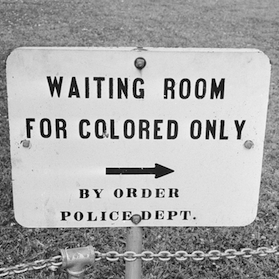
From the 1880s into the 1960s, a majority of American states enforced segregation through “Jim Crow” laws (so called after a black character in minstrel shows). From Delaware to California, and from North Dakota to Texas, many states (and cities, too) could impose legal punishments on people for consorting with members of another race. The most common types of laws forbade intermarriage and ordered business owners and public institutions to keep their black and white clientele separated. Here is a sampling of laws from various states.
Nurses: No person or corporation shall require any white female nurse to nurse in wards or rooms in hospitals, either public or private, in which negro men are placed. Alabama
Intermarriage: The marriage of a person of Caucasian blood with a Negro, Mongolian, Malay, or Hindu shall be null and void. Arizona
Education: The schools for white children and the schools for negro children shall be conducted separately. Florida
Burial: The officer in charge shall not bury, or allow to be buried, any colored persons upon ground set apart or used for the burial of white persons. Georgia
Housing: Any person…who shall rent any part of any such building to a negro person or a negro family when such building is already in whole or in part in occupancy by a white person or white family, or vice versa when the building is in occupancy by a negro person or negro family, shall be guilty of a misdemeanor and on conviction thereof shall be punished by a fine of not less than twenty-five ($25.00) nor more than one hundred ($100.00) dollars or be imprisoned not less than 10, or more than 60 days, or both such fine and imprisonment in the discretion of the court. Louisiana

Theaters: Every person…operating…any public hall, theater, opera house, motion picture show or any place of public entertainment or public assemblage which is attended by both white and colored persons, shall separate the white race and the colored race and shall set apart and designate…certain seats therein to be occupied by white persons and a portion thereof , or certain seats therein, to be occupied by colored persons. Virginia 
Restaurants: It shall be unlawful to conduct a restaurant or other place for the serving of food in the city, at which white and colored people are served in the same room, unless such white and colored persons are effectually separated by a solid partition extending from the floor upward to a distance of seven feet or higher, and unless a separate entrance the street is provided for each compartment. Alabama from http://www.jacksonsun.com
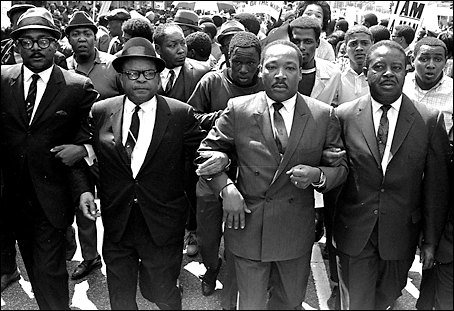
January 20, this year, is the national holiday for the celebration of Martin Luther King, Jr.’s birthday. He was the civil rights leader in the 1960s who worked tirelessly in the style of Mahatma Gandhi using non-violence to get these laws repealed and ensure that Jefferson’s tenet of “all men are created equal” was the law of the land for all.  He was a minister of Christ who wanted change but not violent change. He lead sit-ins, and marches to drew the light to the injustice of these situations, especially in the southern United States.
The local police were not “non-violent” bringing dogs and fire hoses to the marches. 
This was the day I would share with my classes memories of growing up in the Jim Crow South in Virginia. I was and am a primary source of the times. One of the pivotal points was Rosa Parks , an African American women, who refused to give up her seat for a white man. Mrs. Parks was a maid who had worked cleaning for a white family all day and was exhausted. She was arrested for her disobedience and became an instant hero in the Civil Rights Movement. The law stated that people of color must sit in the back of the bus and if a white person needed a seat , the Negroes would have to stand. Mrs. Parks said her money was as good as the white man’s and refused to give him her seat.

“The Help” is a pretty true depiction of what my life was like growing up. My family had “help” cleaning and cooking. The cook was unable to read but she made wonderful fried chicken and other traditional southern dishes. When I saw the film, I was horrified with the bathroom addition, for “the help” and remembered that our house had a bathroom in the basement for the help to use! I wept to see my life in the film from the point of view of the Black American women who did the work in the southern homes. We, my family, were not unkind to these women, they were part of our family except there were boundaries, I didn’t notice as a little girl. They ate in the kitchen and had their own bathroom. I saw the separate signs in Staunton over water fountains, and at bathroom doors, went to the movies where “we” sat downstairs and the Negroes were in the balcony .
Gertie, one of the maids, had been the nursemaid for all the families in my Mama’s family. . . . . a nurse for the new babies. I was her last baby and my family kept her on. She had no family and continued coming to work in our house until she died. My Daddy paid for her hospital and funeral bills. We were her family at her funeral services. Mary, the other maid, came to do the work that Gertie was unable to do as she grew older. Gertie was an honored guest at my wedding. I think she knew we loved her.
I was a product of segregated Virginia public schools. It takes a long time to change hearts and minds. My husband lived in Maryland, and those schools were integrated immediately. Virginia insisted that all the schools were equal. “Separate but equal” but were they ? Of course not! I graduated 10 years after Brown vs. Board of Education, when the Supreme Court ruled full integration in public schools. In Maryland, integration happened immediately, but not in Virginia. I graduated without ever having a black teacher or student in my school.
I remember one of the last classes I taught in Arizona, and the reaction to my tales about Jim Crow. They were horrified and insisted that it wasn’t true. They thought it was one of my “tales”. From their life and perspective it was an impossible situation. I assured them that we have made lots of progress if they felt that way, but we must never forget.
It was just the way it was when I was growing up . . . . . not an excuse but a reason. There is no excuse for this inhumanity that was fostered onto other humanity. In the words chiseled into a stone table at Dachau Concentration Camp in Munich, it must happen “Never Again.”













 TalesAlongTheWay