
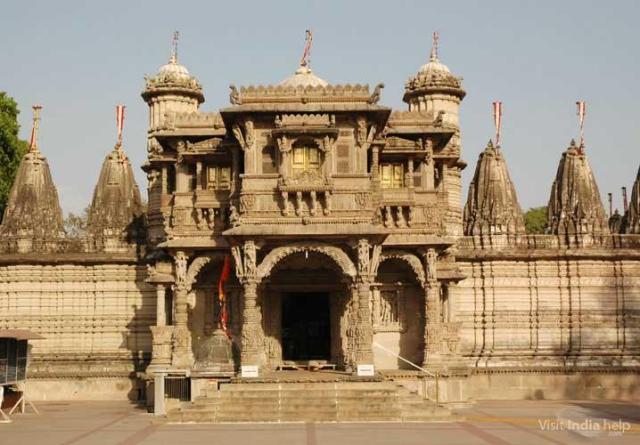
Though Ahmedabad has more than 300 derasars ( Jain temples), this stands apart for its grandeur, craftsmanship, and elegance. Every surface of this large stone complex is covered by painstaking craftsmanship and details of elaborate sculptures of gods and goddesses, musicians and flowers. In the mid 19th century a terrible drought hit this region of the country and many of the skilled artisans came to the city looking for work. This temple provided a livelihood for the craftsmen for a two year period. The style is a combination of Ahmedabad and Jain architecture. The entrance portico resembles the traditional haveli or mansion. There were craftsman and women working to repair the intricate decoration on all the buildings the day we visited.
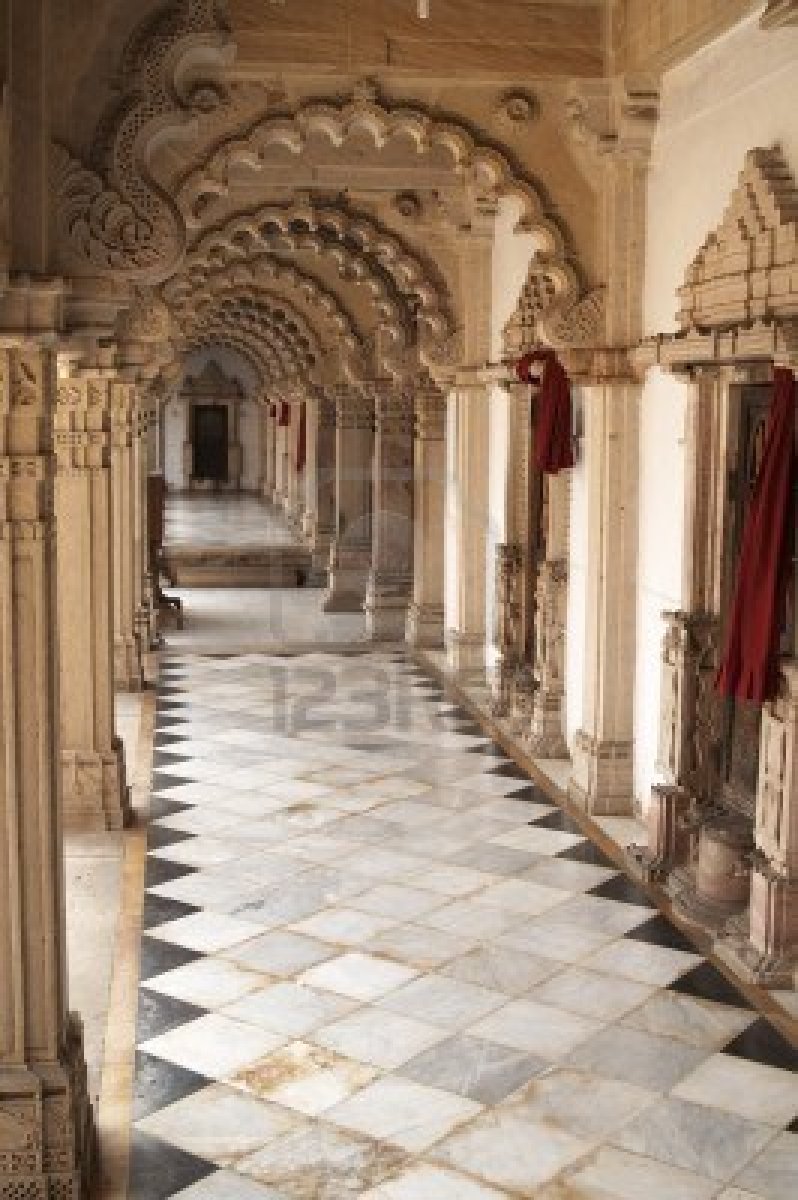
Just to the left as you enter is this colonnaded cloister containing 52 shires. The Jain practice is to detach from the world outside by circumventing the space three times before entering the main space.

This is the main temple which consist of the altar, a closed hall with side porches, a vestibule and a performance hall with three entrances. The morning, we visited there was a wedding taking place. Men were on one side and women and children on the other.

The roof was accessible by small stairs and each of those domes were to commemorate Mount Meru, at the holy source of the Ganges, and home of Shiva. This mountain is holy in Hinduism, Jainism, and Buddhism. In the large entrace courtyard, there is a place to leave shoes. All the temples in India require that shoes be removed. Several in the south, would allow sock feet , but some banned socks, too. When the temperature was well over 100 degrees, walking on the hot stones was quite painful.
This particular temple was designed and begun by Kesreesing Hutheesing one of the very generous and prominent trade merchants in the area. After his untimely death, his wife Harkunvar completed the work. Though she was of modest formal education, she showed a real talent and intelligence for business. Under her managerial skills, she completed this temple, built the Civil Hospital, and established the city’s first girls’ school. All this during the 19th Century when few girls were educated and fewer women were in charge of philanthropic projects.

This pillar of respect or manastambha which is reminiscent of a mosque minaret was built in 2003 to celebrated the 2500 birth anniversary of Mahavira the 24th and last tirthankar or “crossing maker” accredited with establishing the principals of Jainism.
As we left, we all were given a red thread tired around our wrist. We actually still have them on though they have stretched and have needed to be cut back. No one told us what it means, but we think it is a blessing or wish for good luck.
A man was passing out lovely decorated envelopes that Ahmedabad is known for with a new 10 rupee note! We said, we weren’t invited to the wedding. But he smiled and gave us one nonetheless! We kept that for a long time but finally used it for a rickshaw ride!

Examples of the elaborate envelopes made and sold in Ahmedabad.
Namaste. . . .T I I I


Oh the craftsmanship and patience that went into building these! Amazing.
LikeLike
It is indeed! Namaste. . .Anne
LikeLike
🙂
LikeLike
The detail work in these buildings is just amazing.
LikeLike
I love that temple; it is a beauty in Ahmedabad. If you ever get the chance to go to Palitana in the Gujarat State and you love the Jain Temple architecture, it is a must see. Your red string is what you get when you do a puja or blessing ceremony of any sort and it represents you being tied to the prayer with the “Gods” or enlightened ones. Most Indian religions do this and you leave it on until it falls off.
LikeLike
Sorry, it has taken me so long to reply! Check out my post on Palitana and you will see that indeed we did go there! A day, I would just as soon forget! 😎 Namaste. . . .Anne
LikeLike
As a retired Consultant Construction Engineer, I can fully appreciate the architecture and building challenges these constructions presented 🙂
LikeLike
My husband is professor of architecture so our trips have that as central component. I have quite a few posts on Hindu, Sikh temples, Mosques, architecture in Rome. Thanks for stopping by and commenting! Best!
LikeLike