
 |
Growing up just thirty-five miles from Charlottesville in Virginia, spending graduate school years with my husband, and having my son graduate, I hardly had a choice. Everything was Mr. Jefferson this or that. Don’t get me wrong, I love Charlottesville and all that is Jefferson. When my husband was there in grad school for architecture, I encouraged him to learn as much as he could about Jefferson. Being young and foolish, he was all about contemporary design and had little time for the history. Now , of course, I have been proven correct. He is writing about the amazing academical village and innovative plans and ideas Mr. Jefferson had in building his university.
The older I get , the more I admire Jefferson. He was not a perfect man just like the rest of us. It is comforting to know that a man of such brilliance, insight of ideas, and imagination struggled with the insanity of slavery, overspent his budget “big time” leaving his estate deep in debt on his passing, probably fathered children with a slave woman, didn’t set his slaves free even after his death, and struggled with his faith and ideas pertaining to it. Thomas Jefferson at the age of 27 wrote the Declaration of Independence which is one of the most important documents in our history. Yet his slaves were never declared independent.
We took a 3 day road trip to Charlottesville for David to check out some detail of the lawn and range he needed for his book. I thought I would share some of the amazing photos of the Academical Village, Jefferson’s revolutionary idea for the University of Virginia. Jefferson planned his grave marker with the three accomplishments he was most proud of which you see below. Notice that being president was not one of them.

Jefferson wanted the students and faculty to live and learn together. The large domed building was the Rotunda or library as the central focus. There was a lovely green lawn connecting student rooms and pavilions for classrooms and faculty housing on either side. Even today, it is a great honor to live in one of these original rooms where heat is from a wood fireplace and the bathroom is down the way. The faculty who live in the pavilions are there because of the great contribution they have made to the university and the academic world community.
Jefferson was a self-taught architect. He studied classical architecture from books and never visited Rome or Athens. This idea was another extraordinary gift Mr. Jefferson gave to Virginia. The site has won much worldwide recognition for architectural excellence. The really neat thing is that students and dogs with balls, Frisbees, and picnics can sit, play, and enjoy “the lawn” anytime they want!
“For Thomas Jefferson, learning was an integral part of life. The “academical village” is based on the assumption that the life of the mind is a pursuit for all participants in the University, that learning is a lifelong and shared process, and that interaction between scholars and students enlivens the pursuit of knowledge.”

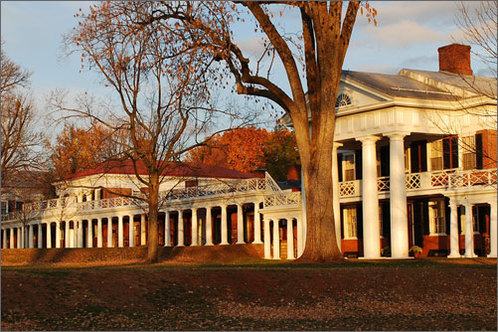


Thank you “T J” for your vision, your leadership, your inspiration, and this amazing place . . . you are a ROCK STAR!
Namaste…….This is the U S A

 TalesAlongTheWay
Reblogged this on Oyia Brown.
LikeLike
Thanks ever so much! Namaste. . . .Anne
LikeLike
Excellent! Great article about a great man even with his warts.
LikeLike
Wow, you said in eleven words what took me paragraphs….I love it! Thanks for stopping by and liking good old T.J. Do write more soon and often…namaste. . . .Anne
LikeLike
Thanks for giving an insight into the life of Thomas Jefferson, the influential visionary who authored seminal forward ways for societies. Love the Academic Village concept. I wonder what he would come up with today?
LikeLike
My pleasure! Mr. Jefferson’s Academical Village is doing well in the 21st Century. But the traffic in Charlottesville has always been a huge problem. The wise man did not foresee cars and all the challenges that entails. He was a veracious reader, who had a book in every room of his home, Monticello, in order to use every “learning” minute while waiting for dinner or a tardy guest. I am thinking his big idea at this moment might be….an e-book in every room. What do you think? Namaste. . .. . Anne
LikeLike
Don’t know about e-books, but I’ve bookshelves just about everywhere, even in the toilet ☼
LikeLike
Well there you go…Mr. Jefferson would approve. You probably know he had a tiny privy off his bedroom/study, but not sure about the bookshelves! He would have if he could have, for sure! Namaste. . . . .Anne
LikeLike
Thank you for bringing back my memories of Mr. Jefferson’s University. I was graduated from the U.Va. School of Law in 1966 and have not returned for a long time (I have lived in the Republic of Panama for about a decade).The old law school building was no longer in use for that purpose when I was last there but a new, far more “modern,” structure had displaced it. “Progress,” I suppose, but it did not sit well.
We referred to him as Mr. Jefferson partly, I suppose, because that was traditional. However, it seems to have been more than that — a high level of regard for Mr. Jefferson as a brilliant, creative man and for the many things he did that enriched our lives as well as the life of our nation.
LikeLike
What fun to have a UVA connection, and both of us so faraway now. My understanding is that faculty and students alike were/are called mister as to not to honor the teacher over the student. Do you remember, too, that all the graduates had black hoods so that there was no partiality by the color of the schools? Now there are Echoles (sp) Scholars who have all sorts of honors from a special building to other distinctions. David says Mr. Jefferson would be annoyed by that practice. There is huge competition by university for the top students as you know, so even Mr. Jefferson’s University had to get into competition.
I think you are very correct, calling him Mr. Jefferson was a sign of respect that carries on even until today.
New Law School is a prominent new building over near the field house. There are lots of changes, but the heart of the campus is just the same. We were there from 1968 -1973. . . .very trying times. David started out in physics in a doctoral program, and then switched to architecture. We witnessed demonstrators yelling through bullhorns from the steps of the Rotunda protesting invasion of Cambodia,and the National Guard being called to lock-down Ch’ville. Mr. Jefferson would have liked the demonstrating, we thought, but not sure about the National Guard. Tanks were parked at the field house!
Thanks ever so much for sharing! . . . .namase. . . . Anne
LikeLike
My understanding is that faculty and students alike were/are called mister as to not to honor the teacher over the student. I do not recall having noticed, because the same tradition had been followed at my undergraduate school up in “YankeeLand.” Students were never referred to in class as other than “Mr.”
As to the black hoods, I don’t recall it but seem to remember that the law school graduation ceremonies were held separately.
“Namaste” to you as well. That was the name of the sailboat on which my wife and I spent several years in the Caribbean and on which we eventually landed in Panama. It was an interesting name, which my wife had chosen. When I went to the immigration office in Trinidad to clear in with our papers, the clerk looked at them (where he saw the name of the boat), looked at me, put his palms together, bowed ever so slightly and said “Namaste.” The population of Trinidad was (and likely remains) about fifty percent of Indian origin, having been brought over as indentured
slavesservants.Dan
LikeLike