Happy Holi!

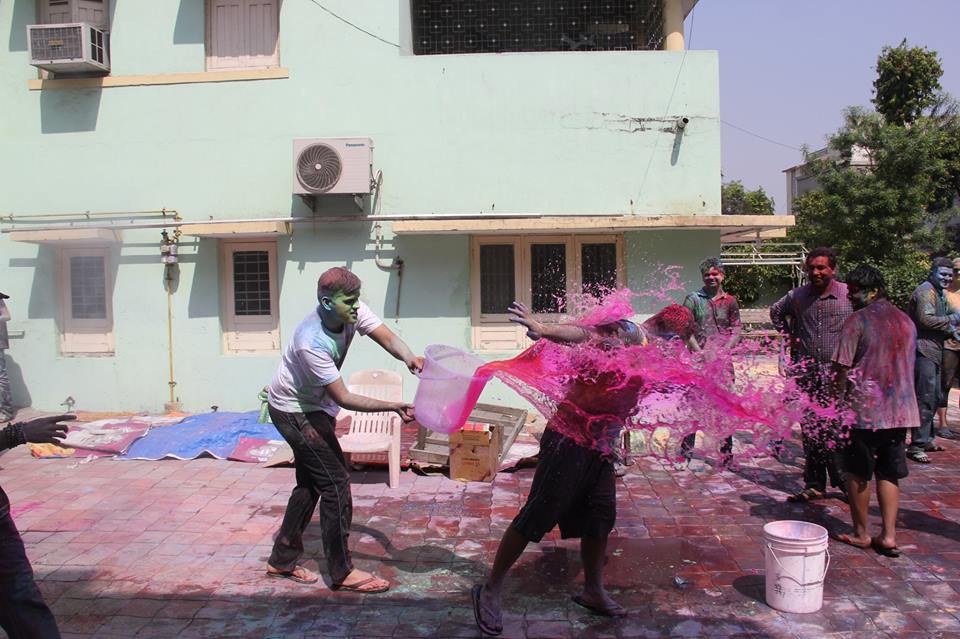
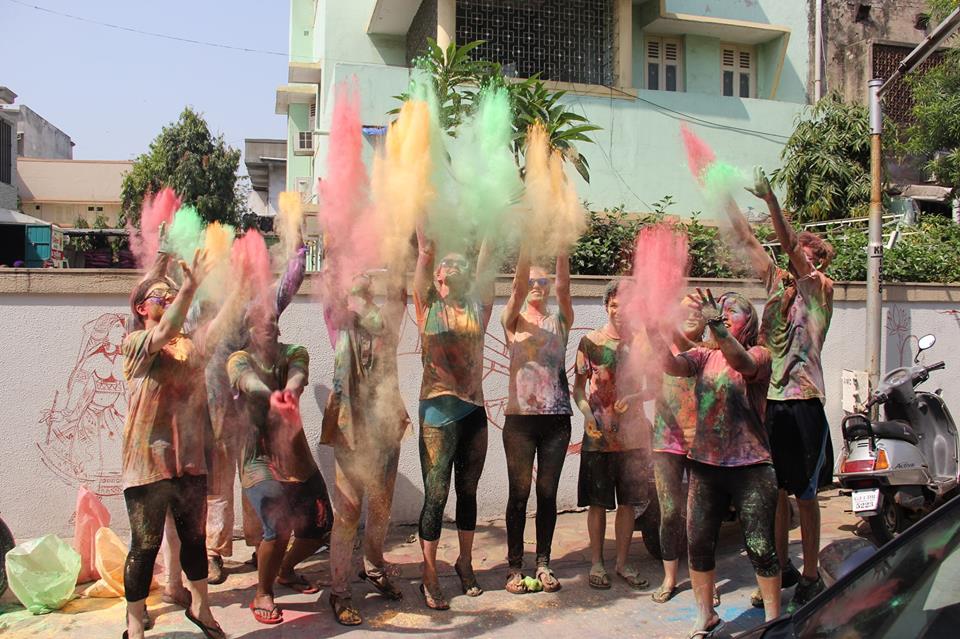
I just got some crazy pictures from yesterday !  Holi is the Spring Festival of Color.  People throw colors, colored water shot from water guns,or buckets of water.   We were with two parties , one a group from CEPT, and the other a group of touring American students who had just arrived in India!  The problem with the buckets of water is that the colors all turn to muddy  color  instead of the vibrant spring colors.  Anyway, you get the idea and can see some of the colors we threw into the air .

Here we were ready to conquer the celbration!

10329165_879581658760523_7819199815895690893_n


Erin, from the last group, had a pink spot in her blonde hair until it grew out!


11046183_879578962094126_8246387160127151508_n


Here it the group  at the end of the festivities.

11043119_879575468761142_6207598847689851415_n


11043119_879575468761142_6207598847689851415_n (1)


And my favorite !

11038124_879573292094693_3811378123865196399_n

It was a fun day that we have been  anticipating  the whole time.  Today we take a train to Jaiput, the Pink City where we will see the Jantar Mantar, the Amber Fort, dancing cobras, and ride elephants,  Agra for the Taj, Amritsar for the Golden Temple, the Massacre garden, and Wagah Border, and my favorite Varanasi .   I have posts on all these places from 2013 if you want to check them out.  We will be traveling by train, bus ,and plane in this huge country.  This North trip is where all the tourists are in India. We no longer are such a sight to the Indians.  It is also the most expensive part of India and dbell went to the back this morning for even more cash!

I am taking my computer in hopes for some time before dinner to blog  if we have WIFI , but if you don’t hear from  me, it because we are touring !  Back home in Amdavad later in the month!

Posted in India, Travel, Uncategorized | Tagged , , , , , , , | 6 Comments

India’s Careful Plan for Growth from The New York Times

JP-INDIA-2-jumbo


India’s Careful Plan for Growth
By THE EDITORIAL BOARDMARCH 6, 2015
Photo

Nanendra Modi’s new budget includes an increase in spending on railways This story is included with an NYT Opinion subscription.
Narendra Modi chose incremental pragmatism in proposing his first full budget since becoming India’s prime minister last year. The $288 billion budget did not fulfill the expectations for economic reform that he has fostered since his election. But he offered enough initiatives on spending, taxes and other areas of economic policy to satisfy many investors for now, and to keep alive hopes that he can guide India to greater growth and development.

The country and its more than 1.2 billion people have voracious requirements. Economic growth is expected to accelerate from 7.4 percent this fiscal year to as much as 8.5 percent in the one that starts next month. But to succeed in building roads, railways and other public improvements and elevating millions of people out of poverty, India will have to sustain an annual growth rate of 9 to 10 percent for over a decade, Finance Minister Arun Jaitley, an architect of the budget, said in New York this week.

One budget proposal, to reduce the corporate tax rate to 25 percent from 30 percent, is intended to attract more investment, which is central to Mr. Modi’s strategy. Other measures include a promise to make the tax structure more transparent and a commitment to introduce a new bankruptcy law in Parliament that would give businesses more certainty.

One of the biggest impediments to investment is India’s hodgepodge of laws under which taxes can be collected at state borders, slowing commerce. The government has promised to establish a new goods and services tax by April 2016 that would unify the disparate laws under one VAT-like system. The restructuring is overdue and the deadline shows the government is serious about getting it done. However, the reform requires a constitutional amendment that must be approved by a two-thirds parliamentary majority and at least half the states. Mr. Modi’s Bharatiya Janata Party controls the lower house of Parliament but not the upper house, so it is unclear whether he can make this happen.

Another big challenge is making people pay the taxes they owe. Since only about 35 million Indians, a mere 3 percent or 4 percent of the population, pay taxes, according to Mr. Jaitley, the government has promised to crack down on tax evasion, including by imposing a penalty of up to 10 years in prison for concealing assets overseas and imposing a new 2 percent tax on the “superrich.”

Mr. Modi made a commitment to give more authority to the states and to provide them with 42 percent of tax revenues compared with 32 percent now, which could give them more reason to work with the federal government on economic reform initiatives. There is no guarantee that states will spend this money wisely, so Mr. Modi will have to monitor the process closely.

Mr. Modi has benefited from an improved global economy, caused in part by lower commodity prices that could save India $50 billion this year, allowing him to provide new welfare programs for the poor. The budget includes a new social security plan to subsidize accident and death insurance and pensions, as well as a major increase, of more than $11 billion, in spending on roads, ports and railways.

The economic climate also enabled Mr. Modi to avoid some spending cuts and relax by one year the target, which the government endorsed last year, for reducing the country’s fiscal deficit to 3 percent of gross domestic product. A more serious weakness is the budget’s failure to make significant changes to India’s enormous subsidy programs for food, fuel and fertilizer.

Opportunity and growth have been stifled by an economy that is centrally directed, overburdened by regulation and plagued by inefficient distribution of aid to the poor. For decades, Indian leaders have promised reform without actually effecting change. Now, a growing population of young people desperate for jobs makes that challenge inescapable. Even many Indians who are not Mr. Modi’s allies are embracing these economic goals and hoping the government carries them out.

image from Giigke Public Domain

Thanks Judy !

Posted in India, Uncategorized | Tagged , , , , , , | Leave a comment

Sunday Shoot. . . . .

unnamed (51)


Check that sign carefully!    That is not a misprint, but the sign in a commercial  where I played a doctor. . . . Dr. Anne Bell last weekend.    easyime.com is the company for whom the commercial was made.

Let me start at the beginning.   CEPT, the University where we are located sent an email about Americans needed in a commercial.  One of the girl’s Jennifer wanted to go and I went just so she wouldn’t have to go alone for the audition.  Long story, short, she decided it was not for her , but  the casting director wanted me to play the doctor. When Jennifer decided not to do it, I sent an email and said, I wouldn’t either.  There were emails back and forth encouraging me to  do the shoot, and I finally agreed.  I do often find it hard to say “no.” unnamed (55)


Here I am dressed the part in this state of the art dental office which was the set.   It was supposed to be in the US so a set which could be pretty universal was chosen.  Easyime.com is an Indian /American company with the goal of bridging the gape between medical exam applicants for  the Green Card and doctors, thus making the whole process easier for everyone.  The founder , Gharmesh Patel learned from personal experience the trials and tribulations fo the green card process.   He  found the medical immigration process complicated , time consuming and expensive.  It needed to be streamlined.  He founded the company, streamlined the process  and also the immigrants will have no charge.  When Dharmesh had applied for his Green Card, he paid an astronomical feel of $600 for his medical exam.  He remembers  and wants to help other immigrants. The fee is now covered  by the doctors in exchange for easyime finding the clients,  making the appointment, and doing much of the paperwork.

Here is another example of the wonderful Indian entrepreneurship. . . . seeing a problem, finding the solutions and working to provide the service.

Here are some of the actors and the small team for the commercial.  I will write more about them in another post.

unnamed (52)


Emily, the immigrant, me , and Mikhil the producer.

unnamed (54)


Here are most of my new friends!

The commercial is for release in the US and will begin airing in New York, California, Texas, and Florida. Let me know if you see it!   And if you know of immigrants ready for the  Medical Examination for their Green Card, let them know about  EASYIME.COM !  The acronym stands for Easy Immigration Medical Exam. . . . .

The shoot was done by CineMAN is the production company and will tell you more about them in another post. They have just had a very successful international film, “Bey Yaar.”

http://www.cineman.in/

Everyone concerned was friendly, kind, patient and welcoming to me. Another experience I will never forget in Incredible India!

I would love to hear your thoughts !

Posted in film, India, Uncategorized | Tagged , , , , , , , , , | Leave a comment

BBC Delhi Rape Documentary. . . Updated

Sad to say this video has been censored. It was available when I posted it this morning, but now it is private.
” The truth shall set you free!”


Just received this from Judy in New York.  As far as I know it was not shown in India.  It is horrible, so be warned.  I have only watched a few minutes of it because today is Holi, the Spring festival of color.  What a contrast to this evil dark story. I am hoping this will go through for those of you to  see this, the evil side of dark sinful  hearts in Incredible India!

 http://youtu.be/Ciow4BmSsNg

I was able to load the following which shows the complete  video .This horrible story is India’s shame and as hinted in the video, India is not the only place where these crimes against women and children are happening. 

http://www.scoopwhoop.com/news/banned-bbc-nirbhaya-documentary/

or here is another link

http://www.dawn.com/news/1167565

Posted in India, Travel, Uncategorized | Tagged , , , | 7 Comments

Travelling Gujuratis. . . . . with Azeem Banatwalla

azeem_banatwalla_c

Here is one of the Breathe In A Bit of Gujurat commercials made by legendary Indian actor, Amitabh Bachchan


My good friend Judy sent me this act.  Gujurat is the state in India where we are most of our four months. Some of the routine, I didn’t understand what he says in Gujurati  as I know 4 words.    I do know that there are  places  in the US known as little Gujurat, like a city, Edison in New Jersey.  I hope my  friends enjoy this.


I would love to hear reactions to the comedy routine. . . . .   

Posted in India, Travel, Uncategorized, USA | Tagged , , , , , , , | Leave a comment

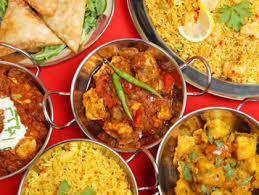
Scientific Proof Why Indian Food Is So Good

images (23)


The Washington Post


Wonkblog
Scientists have figured out what makes Indian food so delicious
Researchers have data crunched 2,500 recipes and found the secret to their success.
By Roberto A. Ferdman March 3 at 8:15 AM

Curries, rice, naan bread, samosas and pakora. (iStock)
Indian food, with its hodgepodge of ingredients and intoxicating aromas, is coveted around the world. The labor-intensive cuisine and its mix of spices is more often than not a revelation for those who sit down to eat it for the first time. Heavy doses of cardamom, cayenne, tamarind and other flavors can overwhelm an unfamiliar palate. Together, they help form the pillars of what tastes so good to so many people.

But behind the appeal of Indian food — what makes it so novel and so delicious — is also a stranger and subtler truth. In a large new analysis of more than 2,000 popular recipes, data scientists have discovered perhaps the key reason why Indian food tastes so unique: It does something radical with flavors, something very different from what we tend to do in the United States and the rest of Western culture. And it does it at the molecular level.

Before we go further, let’s take a step back and consider what flavors are and how they interact. If you were to hold a microscope to most Western dishes, you would find an interesting but not all-too-surprising trend. Popular food pairings in this part of the world combine ingredients that share like flavors, which food chemists have broken down into their molecular parts — precise chemical compounds that, when combined, give off a distinct taste.

Most of the compounds have scientific names, though one of the simpler compounds is acetal, which, as the food chemist George Burdock has written, is “refreshing, pleasant, and [has a] fruity-green odor,” and can be found in whiskey, apple juice, orange juice and raw beets. On average, there are just over 50 flavor compounds in each food ingredient.

A nifty chart shared by Scientific American in 2013 shows which foods share the most flavor compounds with others and which food pairings have the most flavor compounds in common. Peanut butter and roasted peanuts have one of the most significant overlaps (no surprise there). But there are connections that are more difficult to predict: strawberries, for instance, have more in common with white wine than they do with apples, oranges or honey.

Data crunching Indian recipes
Chefs in the West like to make dishes with ingredients that have overlapping flavors. But not all cuisines adhere to the same rule. Many Asian cuisines have been shown to belie the trend by favoring dishes with ingredients that don’t overlap in flavor. And Indian food, in particular, is one of the most powerful counterexamples.

Researchers at the Indian Institute for Technology in Jodhpur crunched data on several thousand recipes from a popular online recipe site called TarlaDalal.com. They broke each dish down to its ingredients, and then compared how often and heavily ingredients share flavor compounds.

The answer? Not too often.

Here’s an easy way to make sense of what they did, through the lens of a single, theoretical dish. Say you have a dish with 4 different ingredients, like the one below:

Each one of those ingredients has its own list of flavor compounds. And any two of those ingredients’ lists might have some overlap. Take the coconut and onion, for instance. We can all agree that these two things are pretty different, but we can also see (in the Venn diagram below) that there’s some overlap in their flavor make-up. (Ignore the math symbols.)

You could create the same diagram for all the ingredients with overlapping flavor compounds, as in this diagram. There are six that have overlap. (Again, ignore the math.)

The researchers did this for each of the several thousand recipes, which used a total of 200 ingredients. They examined how much the underlying flavor compounds overlapped in single dishes and discovered something very different from Western cuisines. Indian cuisine tended to mix ingredients whose flavors don’t overlap at all.

“We found that average flavor sharing in Indian cuisine was significantly lesser than expected,” the researchers wrote.

In other words, the more overlap two ingredients have in flavor, the less likely they are to appear in the same Indian dish.

The unique makeup of Indian cuisine can be seen in some dishes more than others, and it seems to be tied to the use of specific ingredients. Spices usually indicate dishes with flavors that have no chemical common ground.

More specifically, many Indian recipes contain cayenne, the basis of curry powder that is in dishes like red curry, green curry, or massaman curry. And when a dish contains cayenne, the researchers found, it’s unlikely to have other ingredients that share similar flavors. The same can be said of green bell pepper, coriander and garam masala, which are nearly as ubiquitous in Indian cuisine.

download (16)

“Each of the spices is uniquely placed in its recipe to shape the flavor sharing pattern with rest of the ingredients,” the researchers noted.

Milk, butter, bread, and rice, meanwhile—all of which are hallmarks of Western cuisine—were found to be associated with just the opposite: flavor pairings that match. When any of those ingredients appeared in an Indian dish, there was a good chance there would be a lot of flavor overlap.

food-india

A lesson for all chefs
The takeaway is that part of what makes Indian food so appealing is the way flavors rub up against each other. The cuisine is complicated, no doubt: the average Indian dish, after all, contains at least 7 ingredients, and the total number of ingredients observed by the researchers amounted to almost 200 out of the roughly 381 observed around the world. But all those ingredients — and the spices especially — are all uniquely important because in any single dish, each one brings a unique flavor.


But the upshot should also be a thought that we might be approaching food from the wrong angle. Combining ingredients with like flavors is a useful (and often delicious) strategy, but it might be a somewhat misleading rule of thumb. Indian cuisine, after all, is cherished globally, and yet hinges on a decidedly different ingredient pairing logic.

Roberto A. Ferdman is a reporter for Wonkblog covering food, economics, immigration and other things. He was previously a staff writer at Quartz.

Images from Google Public Domain

How many of you enjoy Indian cuisine?  Are there those who have never tried it and or don’t like it ?  I would love to hear! 

Posted in India, Travel, Uncategorized | Tagged , , , , , , , | 9 Comments

The Horror Needs to Be Told

 1357766431

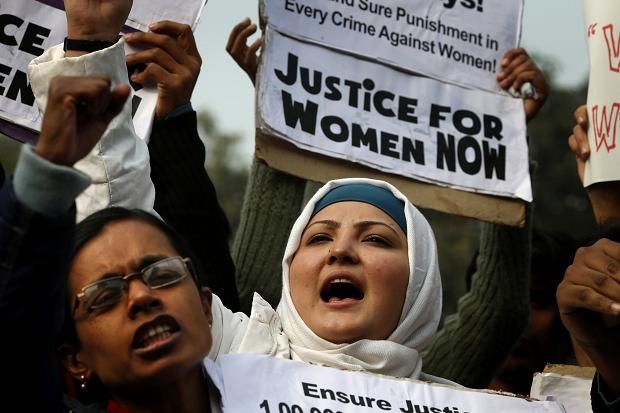
After this horrible rape and murder, there were many protests in India.  We arrived with the first group of students  just weeks afterwards.  The victim was Jyoti Singh, a 23 year old medical student who planned using her life to help and heal others.  She became “India’s Daughter” as people protested. It should not happen to any woman or girl anywhere in India or elsewhere.  The horror of the crime forced  the government to pass a death penalty law and  expedite  the trial.  Now we are hearing from one of the convicted rapists. . . . the bus driver. Education and heart and mind  changes for the public are indeed needed as well as convictions and justice. . . . .swiftly administrated.

F. India

On Death Row, but unrepentant:Delhi gangrape convict says it is the girl’s fault when she was raped. 

by FP Staff  Mar 3, 2015 07:41 IST

#Death row   #Delhi gangrape   #Mukesh Singh   #Rape   #ThatsJustWrong

The horrific Delhi gangrape, in which a 23-year-old medical student was subjected to horrific injury and assault, resulting in her eventual death was widely seen as a wake up call for India on how unsafe women are in India. Even as the 23-year-old girl succumbed to her injuries, people were outraged. The country was suddenly up in arms, politicians shed tears in the Parliament. People wanted justice.
And justice was served. Of the five accused – one was a juvenile – four were given death sentences. Experts on television said that this would serve as an example, a deterrent for rape in country where most sexual assault cases go unreported.
Representational image. ReutersRepresentational image. Reuters
Since then, we have had the Shakti Mills gangrape case, the horrors of Badaun and most recently the Uber cab rape case, and the horrific Rohtak rape case – one of such brutality that it rivalled even the Delhi rape.
And the biggest example of the fact that quick justice is not the only solution, can be found in a documentary titled India’s daughter by Leslee Udwin.
Udwin traveled to India following the Delhi gangrape, moved by the protests, that she said she perceived as a watershed moment. In her documentary, she tried to answer the question, “Why do men rape?”
“Why do men rape?’ I discovered that the disease is a lack of respect for gender. It’s not just about a few rotten apples, it’s the barrel itself that is rotten”, she told the Guardian in an interview.
One of the people Udwin spoke to was Mukesh Singh — one of the perpatrators of the gruesome Delhi gangrape.
He is on death row, but he is not repentant. Singh, who reflects the mindset of many men in India, blames it on the girl. “A girl is far more responsible for rape than a boy. You can’t clap with one hand – it takes two hands.”
And if that is sick, be prepared for more. He says, “A decent girl won’t roam around at 9 o’clock at night. A girl is far more responsible for rape than a boy. Boy and girl are not equal. Housework and housekeeping is for girls, not roaming in discos and bars at night doing wrong things, wearing wrong clothes. About 20 percent of girls are good.”
The Delhi gangrape victim died after 13 days of battling for her life. The media began calling her a ‘braveheart’. She had resisted the rape. And the price she paid for it is well documented. They had inserted an iron bar into her body and pulled out most of her intestines while she was still alive. She underwent five surgeries, where the doctors removed most of her intestines. They said she had suffered serious to her abdomen, genitals and intestines.
Most people in their senses would call what the men did to her inhuman. But according to The Telegraph, Singh described her killing as an ‘accident’ and said such a situation wouldn’t have happened if she didn’t resist. “When being raped, she shouldn’t fight back. She should just be silent and allow the rape. Then they’d have dropped her off after ‘doing her’, and only hit the boy,” he was quoted as saying.
Let alone remorse, Singh thinks that the death penalty would make rapes worse in India. He warns that now rapists will surely kill the victims. The Telegraph quotes him as saying, “Before, they would rape and say, ‘Leave her, she won’t tell anyone.’ Now when they rape, especially the criminal types, they will just kill the girl. Death.”

Your thoughts on this terrible crime. . . . 

Image from Google Public Domain


Posted in India, Travel, Uncategorized | Tagged , , , , , , | 8 Comments

Wedding Filmer in Chandigarh, India . . . . . Nurture

Thanks to my friend, Judy,  for this beautiful wedding video.  She and her husband have gone to many spectacular weddings of family and freinds  in the Punjab.


Thoughts and comments?

Posted in India, Travel, Uncategorized | Tagged , , , , , , | 2 Comments

Heavy Rain On March 1?

1372931229_1372927716_ahmedabad-rain

Yesterday morning we were awakened at 6AM with pounding on the tin roof and loud thunder in the distance !  Honestly, we were not surprised as the weather forecast called for downpours and thunder. Well, during monsoon season this would be  normal, but in our total of 6 months in two trips to Amdavad, this was a first for us.  There are no drains in the streets so water just stands until it evaporates

The whole world appears to be in unusual weather patterns, including monsoon like rains out of season in India !  I am ever so thankful, though that it  was  not feet and feet of snow and below zero temperature!

ahmedabad-rain1

Even this morning, water is still puddled on the streets,  more than 24 hours later !

Images from Google Images, Public Domain

Posted in India, Travel, Uncategorized | Tagged , , , , , , , | Leave a comment

The Wisdom of Mother Teresa

An inspirational woman whose spirit lives on . . . .

Coach Muller's avatarMy Good Time Stories

Photo Credit: Peta_de_Aztian via CC Flickr Photo Credit: Peta_de_Aztian via CC Flickr

How often each day do you really think about helping people that you meet or spend time with each day? Or is your primary focus primarily in determining how much you receive from others? Today’s short story, in which read on kluth.org, is about one of the most humble and caring people that the world has ever known…Mother Teresa.

Mother Teresa visited Australia. A new recruit to the monastery in Australia was assigned to be her guide and “gofer” during her stay. The young man was so thrilled and excited at the prospect of being so close to this woman. He dreamed of how much he would learn from her and what they would talk about.

But during her visit, he became frustrated. Although he was constantly near her, he never had the opportunity to say one word to Mother Teresa. There were…

View original post 144 more words

Posted in Uncategorized | Leave a comment